The Week Ahead: Central Banks Take Center Stage
Markets are heading into the busiest central bank stretch of the year. Three major decisions land within eight days of each other: the European Central Bank today, the Federal Reserve on September 16, and the Bank of England on September 17. Add a stacked US inflation calendar and an oil market reacting to escalating tensions in the Middle East, and this is shaping up to be one of the more consequential weeks of the quarter for gold, the euro, and the pound.
Here is what we are watching, and why it matters.
Gold Holds Above $4,400
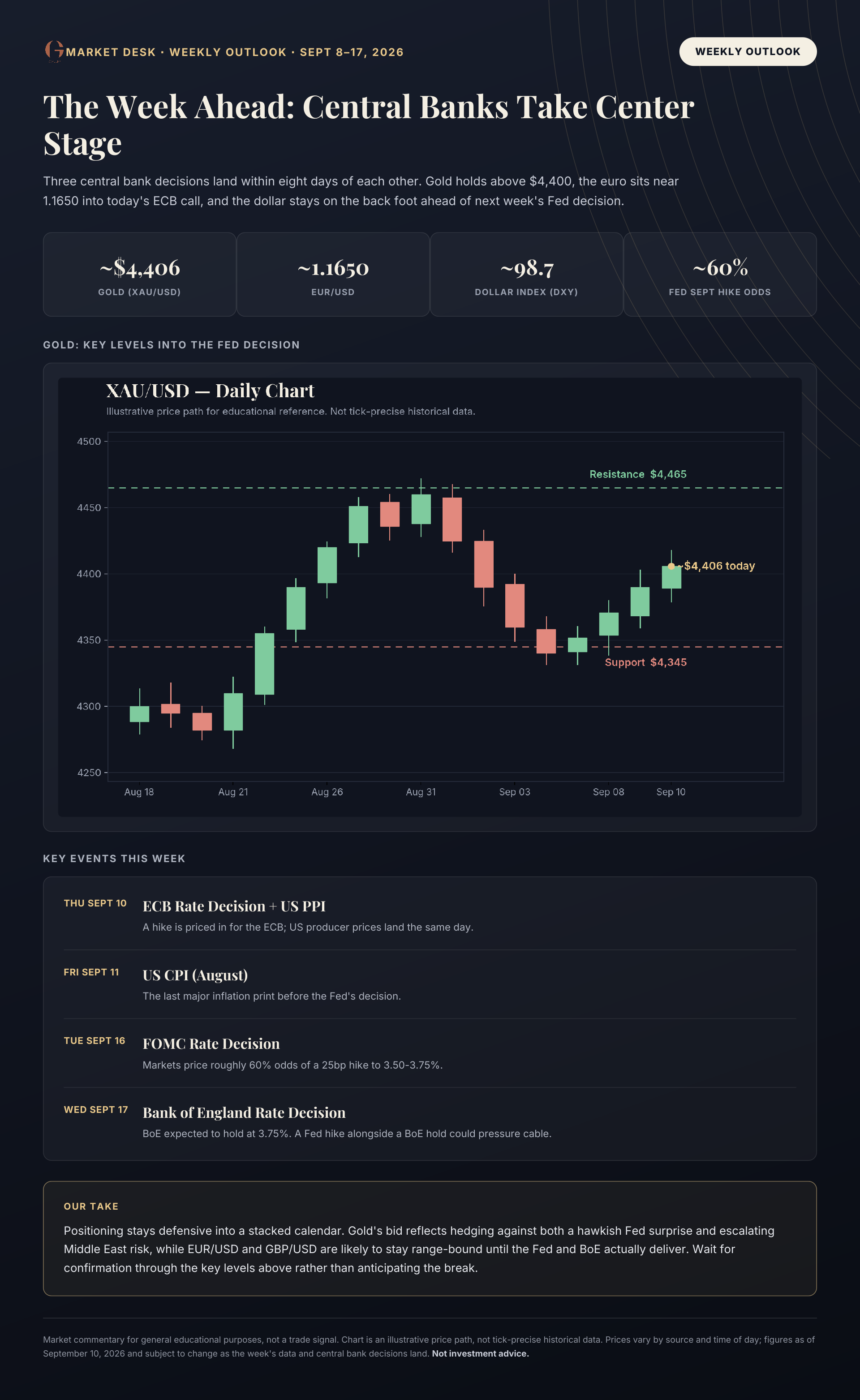
Gold has pushed back above the $4,400 mark, extending its rally as investors position ahead of the week's inflation data and the Fed's decision. The move has been supported by a weaker US dollar and continued demand for gold's hedging appeal, even as rising oil prices and higher bond yields have added some near-term resistance.
The technical picture is constructive but not one-sided. Price is holding above its 100-day moving average, currently near $4,345, which keeps the near-term bias intact. On the upside, the Bollinger middle band around $4,465 is the level to watch. A clean break above that opens the door toward $4,675. On the downside, a deeper pullback would bring the $4,255 region back into focus.
Oil is a genuine wildcard here. Prices have surged to multi-month highs on escalating US-Iran tensions, and that is a two-sided risk for gold: higher oil raises inflation expectations, which can pull forward rate hike bets and weigh on gold, but it also feeds the same safe-haven demand that has been supporting the metal all week.
The Euro and Pound Into Central Bank Week
EUR/USD is holding near 1.1650 as the ECB hands down its own rate decision today. Markets have priced in a hike as the central bank responds to rising inflation risk across the eurozone, and that expectation has been a supportive factor for the euro heading into the meeting. The pair's near-term structure still favors the topside while it holds above 1.1500, with 1.1700 standing out as the level that matters most. A confirmed close above that would open the path toward 1.1805, the upper Bollinger Band and a historically significant rejection zone.
The downside case is straightforward: a break and hold below 1.1500 would shift the focus toward 1.1350, and then 1.1280, which is the level that would meaningfully call the current bullish structure into question.
Sterling is sitting mid-range near 1.354 against the dollar, caught between its own set of considerations. The Bank of England is expected to hold its rate at 3.75 percent on the 17th, one day after the Fed's decision. That sequencing matters. If the Fed delivers a hike while the BoE holds, the resulting policy divergence could put quick pressure on GBP/USD, so this is a pair worth watching closely into the back half of next week.
The Dollar's Retreat
The Dollar Index is trading around 98.7, near its weakest level in roughly four months. Part of this reflects the market pricing in a real chance of Fed action next week, but a rate hike being priced in does not automatically mean dollar strength if the broader growth and yield picture continues to favor the euro and other major currencies. The narrowing GDP growth gap between the US and the eurozone has been part of the story behind the dollar's softer tone this quarter, and that dynamic remains in play heading into next week.
Three Central Banks, Eight Days
European Central Bank, today. A hike is priced into the euro's recent strength. The decision and accompanying guidance will set the tone for EUR/USD heading into next week.
Federal Reserve, September 16. This is the bigger swing factor for every major pair and for gold. Markets are currently pricing roughly 60 percent odds of a 25 basis point hike, taking the target range to 3.50 to 3.75 percent. That is not a settled outcome, and the data landing this week will move that probability in either direction before the meeting.
Bank of England, September 17. The BoE is expected to hold at 3.75 percent. On its own, a hold is unremarkable. Landing one day after the Fed, it becomes the second half of a potential policy divergence trade, particularly for GBP/USD.
The Data That Gets Us There
US producer prices are released today, landing alongside the ECB decision. The consumer price index follows on Friday. Together, these are the last major inflation inputs the Fed will see before its own meeting, and they carry real weight in whether that 60 percent hike probability holds, rises, or fades over the coming days.
Our Take
We are treating this as a week to respect the calendar rather than get ahead of it. Positioning across gold, EUR/USD, and GBP/USD looks broadly defensive, which is consistent with a market waiting for three separate central banks to actually deliver before committing to the next leg of a move. Gold's bid looks like a genuine hedge against both a hawkish Fed surprise and further Middle East escalation, not a directional bet in either direction. EUR/USD and GBP/USD are likely to stay range-bound within the levels outlined above until the Fed and BoE decisions are behind us.
Our general approach into weeks like this is to wait for confirmation through the key levels rather than anticipate the break. Chasing a move a day or two before a major central bank decision is one of the more common ways traders give back an otherwise good week.