🥇 Gold Holds Near $4,165 as Fed Rate Hike Concerns Limit Recovery
📈 Technical Analysis of XAU/USD
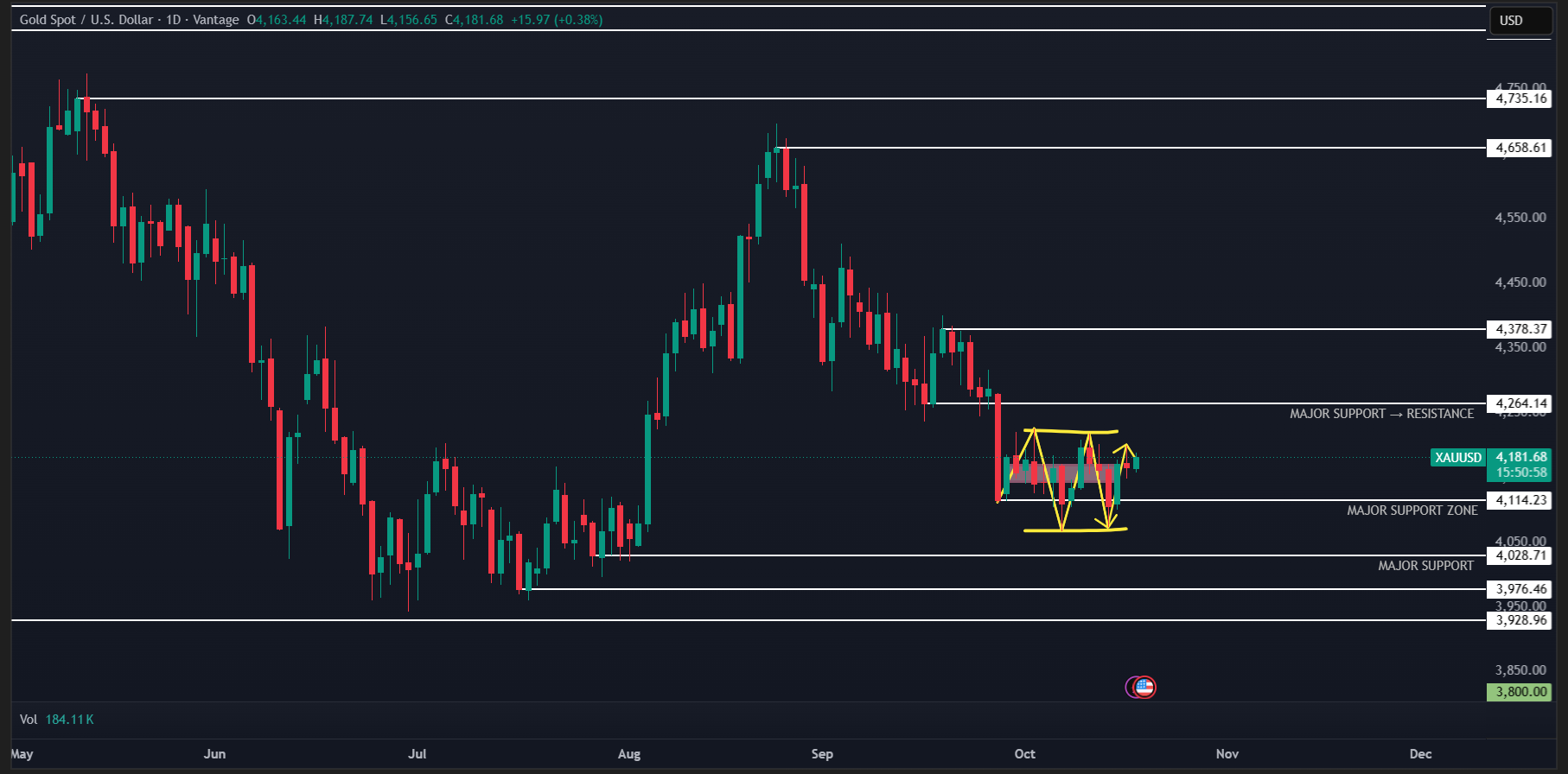
XAU/USD maintains a bearish broader technical bias despite its recent recovery, trading around 4,165 after rebounding from the 4,145 region. Gold briefly climbed toward 4,200 before retreating, suggesting that sellers remain active at higher price levels. The broader bearish structure remains intact while prices trade below the major 4,265 resistance level.
RSI (14) at 47.07 indicates weakening bearish momentum, recovering toward the neutral 50 level as buyers attempt to regain control. However, the indicator remains below 50, suggesting that bullish momentum has not yet been firmly established.
MACD signals improving short-term recovery momentum: The MACD line has crossed above the signal line, while the positive histogram is widening slightly. Although both lines remain below zero, the bullish crossover suggests selling pressure is easing and a potential recovery is developing.
Moving averages reinforce the broader bearish technical structure: Gold is testing the 20 EMA near 4,205 as immediate resistance while remaining below the 50, 100 and 200 EMAs. This indicates that the short-term recovery has not yet reversed the medium- and longer-term bearish trend.
Bollinger Bands indicate declining volatility and consolidation: Gold has rebounded from the lower band and is approaching the middle band near 4,200, which could act as immediate resistance. Narrowing bands suggest reduced volatility following the recent selloff, potentially preceding a stronger directional move.
4,265 remains the major resistance bulls need to reclaim, with a sustained breakout potentially exposing 4,380, followed by 4,660. Conversely, renewed selling pressure below 4,145 could trigger another decline toward 4,030, followed by 3,975 and 3,930.
📋 Overview
Gold consolidated around $4,165–$4,175 following a volatile trading session, having briefly recovered toward 4,190–4,200 before encountering renewed selling pressure. Buying interest around the 4,145 support region helped limit further losses, although the recovery remains constrained by nearby resistance.
A weaker US dollar and declining Treasury yields provided support, while persistent US inflation and uncertainty surrounding Federal Reserve interest-rate decisions continued to limit gold's upside. Safe-haven demand linked to equity-market weakness and Middle East geopolitical tensions also contributed to buying interest.
XAU/USD remains below all four major EMAs, maintaining its broader bearish technical structure despite improving short-term momentum. A sustained recovery above 4,265 could open the way toward 4,380, while a breakdown below 4,145 could expose 4,030 and 3,975.
🔎 What Drove The Gold Price Down?
Federal Reserve Rate Hike Expectations Limited Gold's Recovery: Uncertainty surrounding future US interest-rate increases continued to weigh on gold. Although Fed Chair Kevin Warsh avoided committing to another increase in October, markets continued to price in approximately a 90% probability of a December rate hike, limiting demand for non-yielding assets.
Persistent US Inflation Reinforced Interest-Rate Concerns: September US CPI increased 3.7% year-on-year, while producer prices rose 6.3% annually. These elevated inflation readings reinforced expectations that the Federal Reserve could maintain restrictive monetary policy, creating resistance to a sustained gold recovery.
Weaker US Dollar and Falling Treasury Yields Provided Support: The US dollar headed toward its first weekly decline in four weeks as Treasury yields retreated. Lower yields reduced the opportunity cost of holding non-yielding gold, helping prices recover toward 4,190 before selling pressure returned.
Safe-Haven Demand Helped Limit Further Losses: Weakness in equity markets, particularly technology stocks, encouraged investors to seek defensive assets such as gold and US government bonds. This demand supported gold near its recent lows, although it was insufficient to overcome resistance around 4,190–4,200.
Middle East Geopolitical Tensions Created Conflicting Pressures: Escalating tensions involving Iran, Saudi Arabia and Houthi forces, alongside disruptions around the Strait of Hormuz, maintained demand for safe-haven assets. However, higher energy prices also increased inflation concerns, reinforcing expectations of restrictive US monetary policy and limiting gold's recovery.