🥇 Gold Holds Above $4,100 as High Treasury Yields Offset Safe-Haven Demand
📈 Technical Analysis of XAU/USD
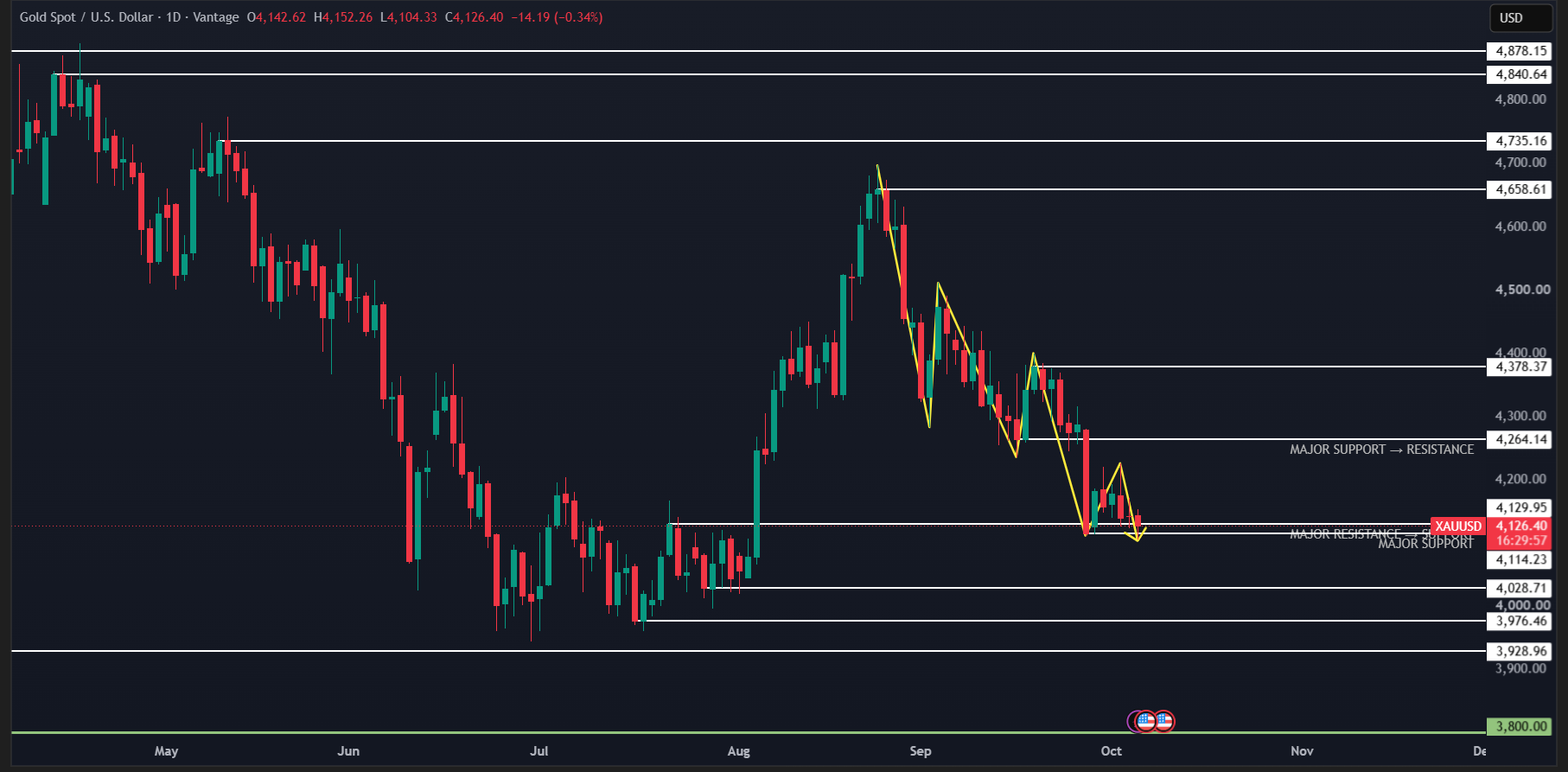
XAU/USD remains under bearish pressure around 4,125, maintaining a sequence of lower highs and lower lows. Buyers continue to defend the area immediately above 4,100, but price has yet to establish a meaningful recovery.
RSI (14) at 38 reflects bearish momentum, although the indicator remains above oversold territory, suggesting that further downside remains technically possible before oversold conditions develop.
MACD remains bearish, trading below its signal line and in negative territory, confirming that downside momentum continues to dominate the short-term structure.
Moving averages reinforce the broader bearish trend: gold remains below the 20, 50, 100 and 200 EMAs, creating multiple layers of overhead resistance. Price also remains close to the lower Bollinger Band, while the relatively wide bands reflect continued elevated volatility.
4,115–4,130 remains the immediate support region to watch. A recovery above 4,130 could shift attention toward 4,265 resistance, while a decisive break below 4,115 could expose the next major support around 4,030.
📋 Overview
Gold remained above the psychologically important $4,000 level, with XAU/USD holding around 4,100–4,150 despite exceptionally high global bond yields and continued US dollar strength.
Elevated US Treasury yields remained the primary headwind, increasing the opportunity cost of holding non-yielding gold and limiting the metal's ability to stage a stronger recovery.
Safe-haven and structural demand continued to cushion the downside, with central-bank demand, geopolitical uncertainty and concerns over rising global debt providing longer-term support.
🔎 What Drove The Gold Price Down?
Elevated Treasury Yields: US long-term Treasury yields remained close to multi-decade highs, increasing the opportunity cost of holding non-yielding bullion and creating a major headwind for gold.
US Dollar Strength: Broad demand for the US dollar added further pressure to dollar-denominated gold and helped restrict the metal's recovery.
European Fiscal Stress Cushioned the Decline: Concerns surrounding France increased demand for defensive assets, partly offsetting the pressure created by elevated yields and dollar strength.
Central-Bank Demand Provided Underlying Support: Central bankers continued to highlight gold's role as a strategic reserve asset, helping maintain longer-term demand despite the challenging high-yield environment.
Geopolitical Uncertainty Maintained Safe-Haven Demand: Persistent instability in the Middle East preserved an underlying safe-haven premium, helping gold remain above key psychological levels even as short-term monetary conditions remained bearish.