🥇 Gold Heads for Weekly Decline as Strong Dollar and Fed Rate-Hike Bets Weigh
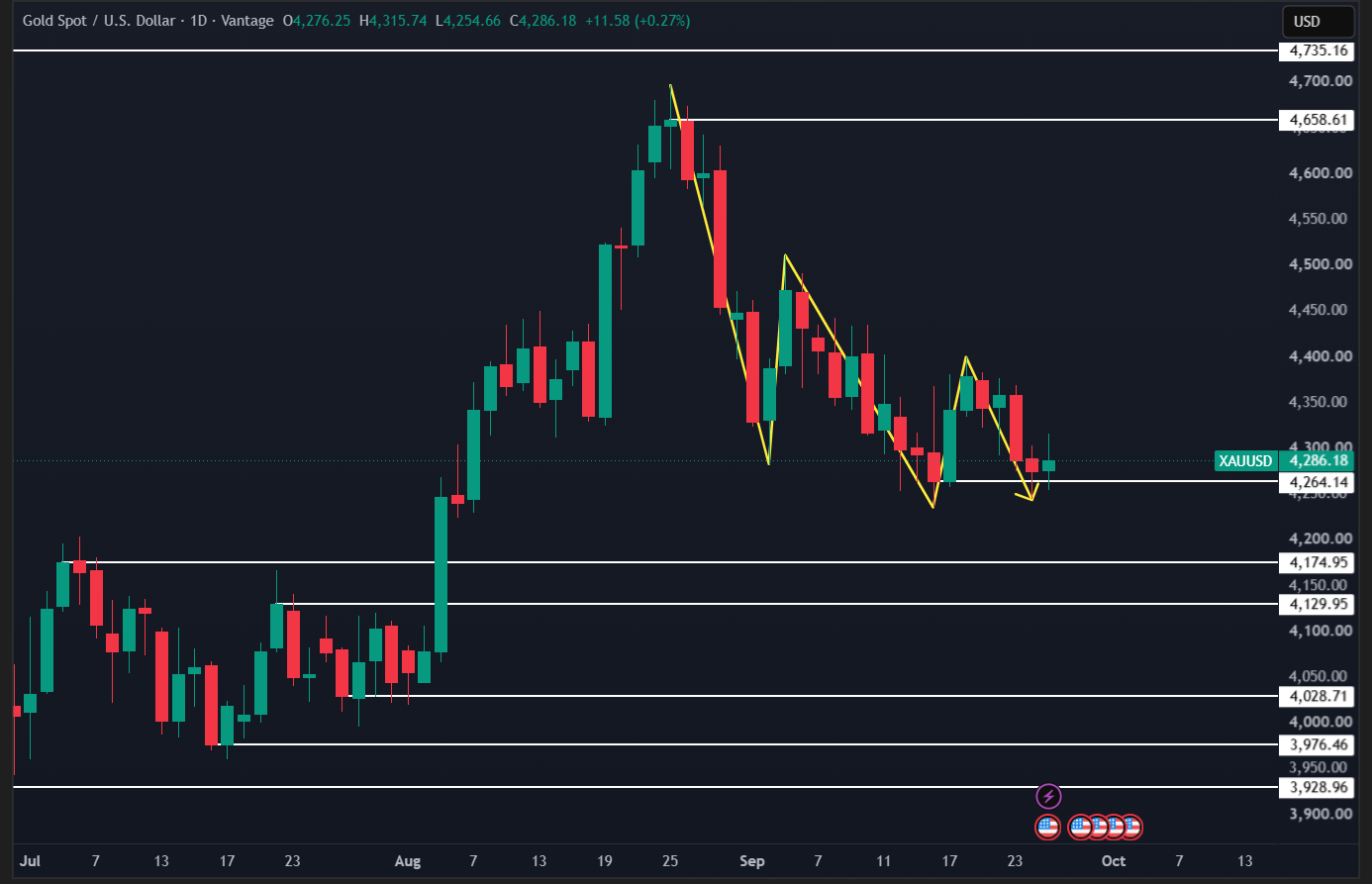
📈 Technical Analysis of XAU/USD
XAU/USD is attempting to stabilize around $4,285 following its September decline, but recovery attempts continue to face resistance beneath the clustered moving averages, keeping sellers in control of the broader price structure.
RSI (14) at approximately 45 reflects bearish momentum, with the indicator remaining below the neutral 50 level but not yet reaching oversold territory.
MACD remains bearish, with the negative histogram confirming that downside momentum remains present despite gold attempting to stabilise around current levels.
The EMA and Bollinger Band structures maintain the bearish outlook: gold remains below the 20, 50 and 100 EMAs, leaving these averages as overhead resistance, while price also remains below the 200 EMA, maintaining the longer-term bearish structure. Gold remains in the lower half of the Bollinger Bands, while narrowing bands signal declining volatility and consolidation.
A sustained recovery above $4,385 could shift attention toward $4,450 and eventually $4,660. Conversely, a breakdown below $4,265 would expose major support at $4,175, followed by $4,130.
📋 Overview
Gold remained around the 4,270-4,300 region on Friday and headed toward a weekly decline, as US dollar strength and elevated Treasury yields continued to pressure the non-yielding metal.
Markets repriced the Federal Reserve outlook toward further tightening, following September's rate increase, resilient US economic conditions and renewed concerns that inflation could remain elevated.
Middle East tensions continued to provide underlying safe-haven support, but geopolitical demand was insufficient to offset the negative impact of higher Treasury yields and a stronger US dollar.
🔎 What Drove The Gold Price?
Stronger US Dollar: The dollar was on course for a second consecutive weekly advance, making dollar-denominated gold more expensive for overseas buyers and restricting XAU/USD recovery attempts.
Fed Tightening Expectations: Markets continued to price the possibility of additional Federal Reserve rate increases following September's hike, maintaining pressure on non-yielding gold.
Surging Treasury Yields: Long-dated US Treasury yields climbed to their highest levels in more than two decades, increasing the opportunity cost of holding non-interest-bearing bullion.
Oil-Driven Inflation Risk: Brent crude remaining above $100 reinforced concerns that inflation could stay elevated and require tighter monetary policy, creating another headwind for gold.
Geopolitical Support Remained: Continuing Middle East risks maintained some underlying safe-haven demand and limited the scale of gold's decline, although this support was insufficient to overcome the pressure from higher yields and dollar strength.