Gold & Energy: The Shock Has Changed, Not Disappeared
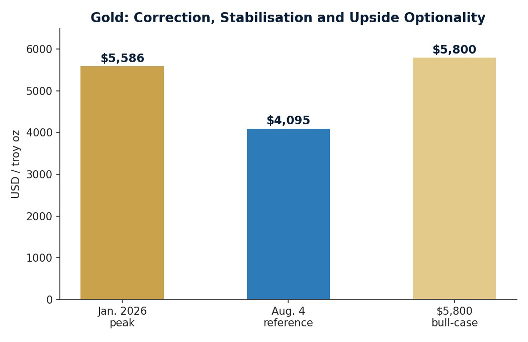
Gold remains firmly in play, but one factual distinction matters. Gold's January 2026 peak was around $5,586/oz; $5,800 is better treated as a forward bull-case/forecast level rather than the current market high. Spot gold was around $4,095/oz on 4 August. The correction from the January peak has therefore been significant, but the long-term macro case has not disappeared.
Gold can benefit from several forces simultaneously: geopolitical risk, central-bank demand, uncertainty over fiscal and monetary policy, and renewed inflation concerns. We therefore remain constructive on gold, particularly if real rates soften or geopolitical risk persists.
Energy: Less 1970s, More Specific Transmission Channels
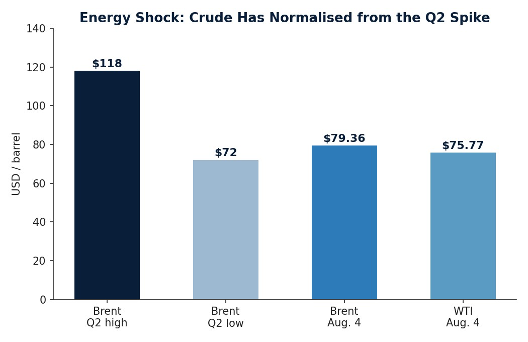
The current energy shock is materially different from the 1970s in transmission. The key pressure has been concentrated in disrupted flows and refined products — particularly distillates and jet fuel — rather than a simple, uniform crude-oil shock. EIA data show Brent traded as high as $118/bbl in Q2 before falling to $72, while the 4 August reference was $79.36/bbl. WTI was around $75.77.
This normalisation is constructive for risk assets. If oil remains contained, the inflation impulse from the conflict can fade. If supply disruptions return and crude or refined products re-accelerate, the Fed's job becomes materially harder.
Markets Charts
Market Outlook & Key Considerations
Maintain a constructive, hedge-oriented allocation to gold, sized to benefit from continued geopolitical risk, central-bank demand and any softening in real yields, while recognising the January highs are not the current reference point.
On energy, stay tactical rather than directional. Monitor refined-product spreads (distillates, jet fuel) as the more sensitive early-warning indicator of renewed supply stress, rather than headline crude alone. A re-acceleration in either crude or refined products would materially complicate the Fed's inflation outlook and warrants a faster portfolio response than a simple headline oil move.
Insights
The market is telling us something important: it has absorbed a geopolitical shock, an energy shock and a period of AI-related anxiety — and it has still returned to all-time highs. That is resilience. But resilience should never be confused with invulnerability.
I believe we are moving into a market where investors need to be faster, more selective and more willing to reposition. The opportunity is not simply to own the index. It is to identify the businesses and assets that continue to deliver when the macro environment becomes noisy. I remain constructive on high-quality U.S. equities and on gold, while keeping a close eye on concentration risk, rates and the political calendar.
Analyst consensus points to a pullback in the coming months, with a mild correction likely by year-end. My view: watch tech concentration closely. So much of the market's rally has been driven by a narrow set of AI names — diversifying across sectors remains one of the simplest ways to manage that risk.
On gold and energy: the correction in gold and the normalisation in crude are genuine signals of de-escalation, but neither market has fully closed the door on renewed volatility. Bottom line: The bull market remains alive. The edge now comes from positioning, not prediction.