Deep Dive: The Oil Export Ban Trade
Everything in this thesis hangs on one switch, and right now it is off. An export ban would split the oil market in two, with consequences for inflation, currencies and chips. Without the ban, none of what follows plays out.
The trigger: no ban, no trade
The rule for this trade is simple: a ban means the problem is real, and no ban is posturing. The pressure is real, but the ban itself is not close.
The calls are real. Two House bills would ban diesel exports. H.R. 10423 would ban them immediately until the end of the year. H.R. 10422 would trigger a ban automatically if diesel averages more than $5.00 a gallon over two weeks. Diesel hit a record $6.529 a gallon on September 21, according to the EIA.
The White House has said no. After first floating a ban, President Trump said on October 3, "We're not going to be doing the export ban," and added, "we were never going to do it." The G7 agreed not to limit energy exports to each other and promised a front-loaded release of diesel reserves. Earlier in the war, a Trump official said oil and gas export restrictions were not under consideration.
The market has priced it down. Benzinga describes the odds of a diesel ban as having collapsed.
Note what is actually on the table: diesel, a refined product, not crude. The crude mechanism described below needs a crude export ban, and the proposals in Congress cover diesel. For now, the posture leans toward no ban.
How a ban would split WTI and Brent
A ban would trap American crude at home and pull barrels out of the world market.
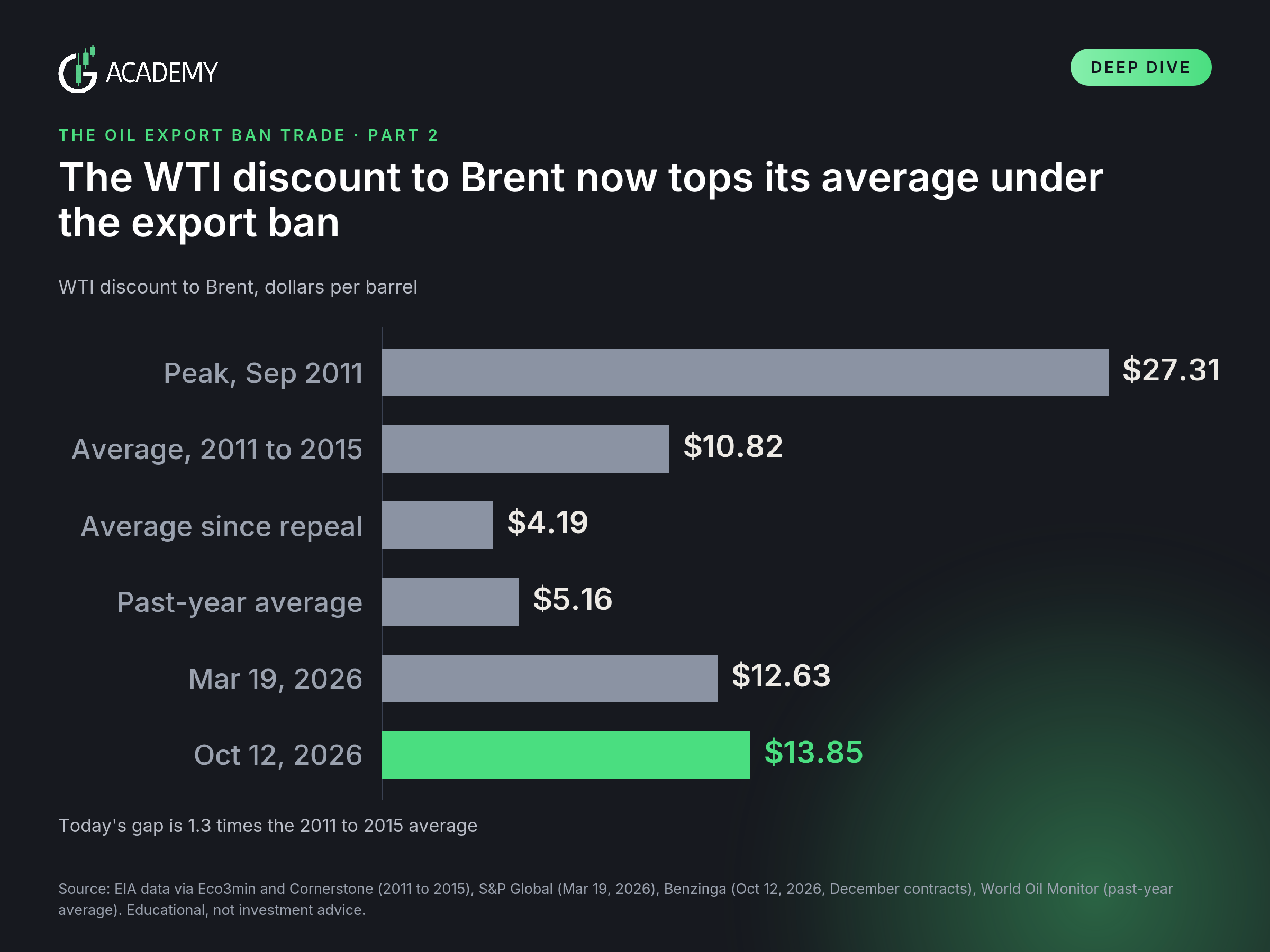
The mechanism is simple. If US crude cannot leave, it piles up on the Gulf Coast, where refiners are not set up to absorb all of it, so WTI falls. The barrels missing abroad tighten supply internationally, so Brent rises. That is the USO and BNO split: USO tracks front-month WTI futures and BNO tracks front-month Brent futures, so a wider gap favors BNO over USO.
The history supports it. During the 1975 to 2015 ban, a Cushing bottleneck and the ban together pushed WTI's discount to as much as $27 in 2011, and it averaged $10.82 from 2011 to 2015. After the ban ended in December 2015, it fell to an average of $4.19.
The split has already started without a ban. Brent December futures traded at $106.30 on October 12 against $92.45 for WTI, a $13.85 gap. Over the past month BNO gained 8.7% while USO slipped 0.4%. The causes are record tanker rates, with supertanker rates near $1.3 million a day and Gulf freight around $33 a barrel, plus September's diesel ban speculation. A real ban would push the gap further, but part of this trade is already in the price.
A diesel ban would work differently. Diesel output cannot be cut without cutting overall refinery runs, so refiners could process less crude and make less gasoline, which analysts warn could backfire. In the short run it could leave refiners with a surplus and push US diesel prices down relative to the rest of the world.
Why the rest of the world pays
If American crude stays home, buyers abroad compete for fewer barrels. Brent rises, and oil-importing countries pay more for it in dollars.
That hits importers twice. Oil is priced in dollars, so a stronger dollar raises the local-currency cost again. Importers also have to find dollars to pay for it, which pushes their currencies down. Korea shows the channel this year. When the war pushed WTI above $100 in late March, the won fell past 1,510 per dollar, its weakest since 2009, and it reached 1,562 in June. When oil eased in October, the won jumped to about 1,333 on October 12, a two-year high. The dollar index, meanwhile, touched a 17-month high.
Shipping adds a second layer. Record tanker rates, near $1.3 million a day for supertankers, make it more expensive to move fuel and goods everywhere. Together these produce the outcome that matters: a strong dollar and global inflation at the same time, with the cost shock landing hardest outside the US.
What 2020 really looked like
The comparison to 2020 holds in structure but not yet in size. In 2020 and 2021 the money supply (M2) grew by more than 25%, the fastest since World War II. Inflation stayed low through 2020, then climbed above 4% by spring 2021 as supply chains jammed, and peaked at 9.1% in June 2022. The sequence was money first, supply constraints second, and the price spike after both.
Today the first leg is much smaller. M2 was $23.34 trillion in August, up 5.7% from a year earlier. That is the fastest growth since June 2022, but a fraction of the 2020 to 2021 pace. The Fed raised rates in September for the first time in three years and has been running reserve management purchases. Inflation was 3.4% in August, and forecasts for September are 3.6% to 3.7% for the headline and about 2.5% for core, with most of the rise coming from record gasoline prices.
That is why the supply leg matters. Money supply alone is not producing a 2020-style shock. An export ban that tightened energy and shipping would add the second leg, the one that turned 2021 into a price spike.
The playbook
Because the trigger is off, this is a plan for if the switch flips, not a position for today.
The oil expression. The cleanest oil trade is the spread, BNO against USO, not oil in general. A ban lowers US crude and raises Brent at the same time. Tanker and shipping stocks are another way to express the freight leg. Tanker rates near $1.3 million a day have helped nine shipping stocks double this year, according to Benzinga.
What worked last time. In the 2020 to 2021 episode, technology led because the big companies held large cash piles. The argument now is that much of that cash has since gone into AI spending.
What could work now. Chips and memory. The case is that they have already lived through demand-driven price pressure from AI and kept their pricing power. SK hynix reported a 72% operating margin in the first quarter of 2026.
The point is to prepare for a real inflation shock, not the "prices are already high" kind. If the ban never comes, there is nothing to trade.
The Korea angle: EWY
EWY is Korea with a chip engine. SK hynix (24.1%) and Samsung Electronics (23.5%) together make up about 48% of the fund, and the top ten holdings are 62%, as of October 9. The fund trades at about 13 times earnings.

The argument is that global inflation would weaken the won and nominally lift Korean stock prices, as it did for Argentina in 2021. The currency leg needs care, for two reasons.
The won has already moved the other way. After sinking to 1,562 per dollar in June, its weakest since 2009, it rallied to about 1,333 on October 12, a two-year high, as oil eased. Korea imports most of its oil, so a new oil shock would likely push the won down again, but the starting point is not weak.
EWY is priced in dollars. A weaker won lowers the dollar value of every Korean share in the fund. Argentina shows how large that effect is. The Merval rose 63% in pesos in 2021, but the peso lost about a fifth of its value against the dollar that year, so a dollar investor earned far less. This year, a 29% twelve-month gain in pesos shrank to a much smaller return after the peso fell roughly 30%.
Samsung and SK hynix earn much of their revenue in dollars, and Korean companies say a weaker won is largely offset by higher export earnings. That cushions the hit, but for a dollar investor EWY still needs Korean stock prices to rise by more than the won falls.
What to watch, and what breaks the thesis
Signs a ban is becoming real:
A reversal in Washington. Any change from the White House, or a leadership vote on H.R. 10422 or 10423. Diesel has been well above the $5.00 level that would trigger the automatic ban in H.R. 10422.
A split with the G7. The G7 agreed not to limit energy exports to each other, so a break from that would be a major signal.
The spread. A Brent-WTI gap pushing past $14 without new freight news.
The dollar and the won. The dollar index is near 102 after its 17-month high, and the won is at about 1,333, a two-year high.
Inflation data. September CPI on October 14, PPI on October 15, and the Fed's decision on October 28.
What breaks the thesis:
No ban. The administration and the G7 have said no, and the Russian diesel deal moves the other way by adding supply, although bipartisan senators are objecting to it.
A ceasefire. Easier freight and lower oil would unwind the spread and the shipping rally.
A strong won. It removes the currency tailwind that the EWY argument depends on.
Concentration. EWY is mostly two stocks, so a turn in the memory cycle would hit the fund whatever the oil market does.
Until the switch flips, this is a map, not a position.