Deep Dive: The Nvidia Affair and What It Means for the AI Trade
The market's first reaction to Jensen Huang's admission was a 4% drop in Nvidia on a day the S&P 500 rose 2.35%. The affair itself is a personal matter. What gives the story market weight is the alleged link to Chinese intelligence, and what that could change for export controls, Nvidia's suppliers and its leadership. This report lays out the facts, the thesis for how it could play out, and the dates that matter.
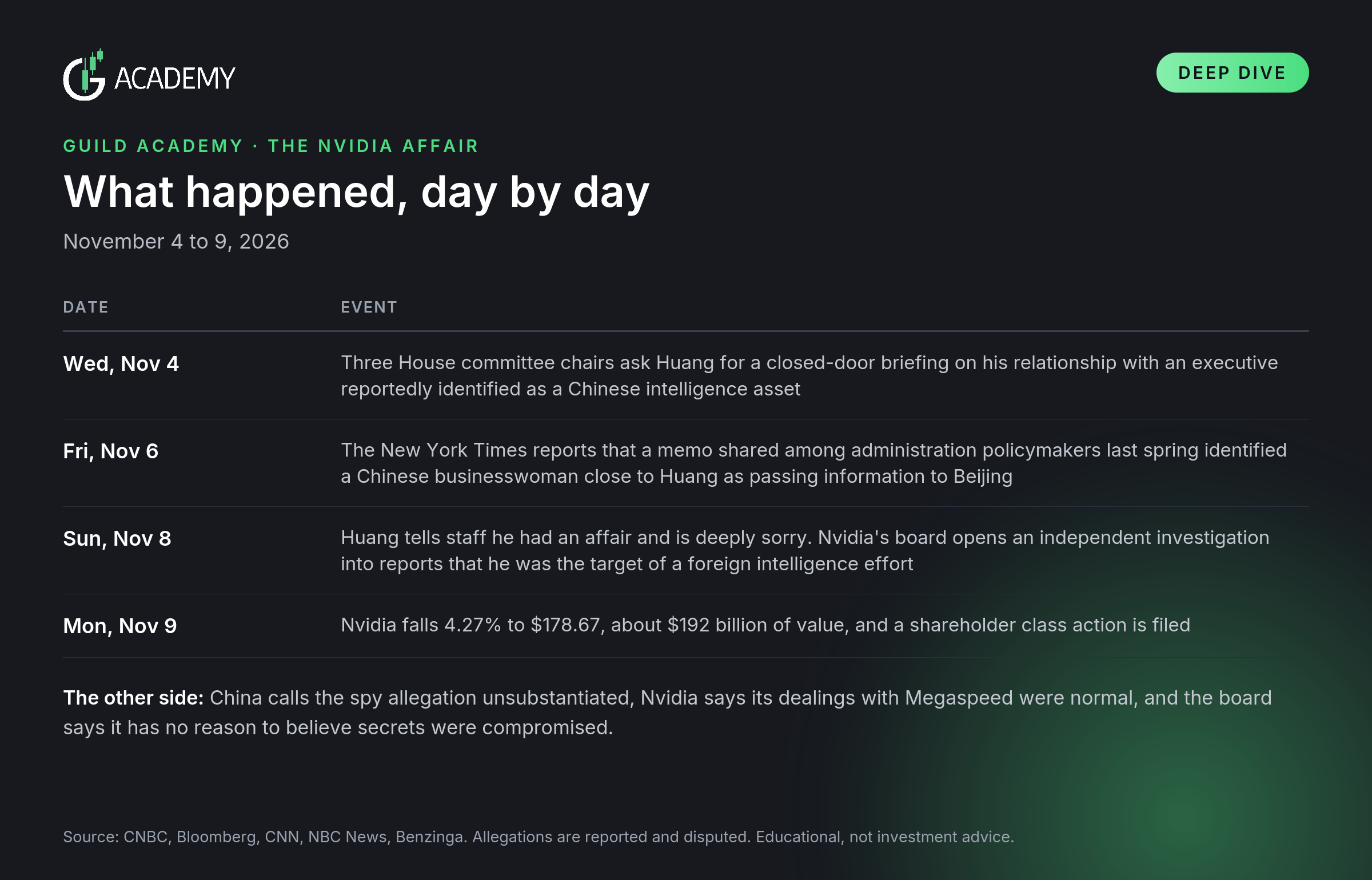
The people and the company. The woman is Alice Huang, an executive at Megaspeed, a Singapore-based cloud company and Nvidia customer. The House Select Committee on China has called her a publicly reported Chinese intelligence asset. Megaspeed denies wrongdoing, and Commerce Department officials have been examining whether it helps Chinese companies get around US export restrictions on AI chips.
The other side of the story. China's Foreign Ministry says the spy allegation is unsubstantiated. Nvidia says its dealings with Megaspeed were not unusual, and its board says it has no reason to believe any secrets were compromised. President Trump said Huang told him he had no idea she was a spy. Nvidia has said Huang is committed to continuing as CEO.
Not the First CEO Scandal
Wall Street has seen executive scandals before. Intel's CEO Brian Krzanich resigned in June 2018 over a consensual relationship with an employee that broke company policy. McDonald's fired its CEO Steve Easterbrook in November 2019 for a consensual relationship with an employee. In both cases the story was a personal relationship inside the company, the board acted, and leadership changed. Neither involved an alleged foreign intelligence link.
That is the difference this time:
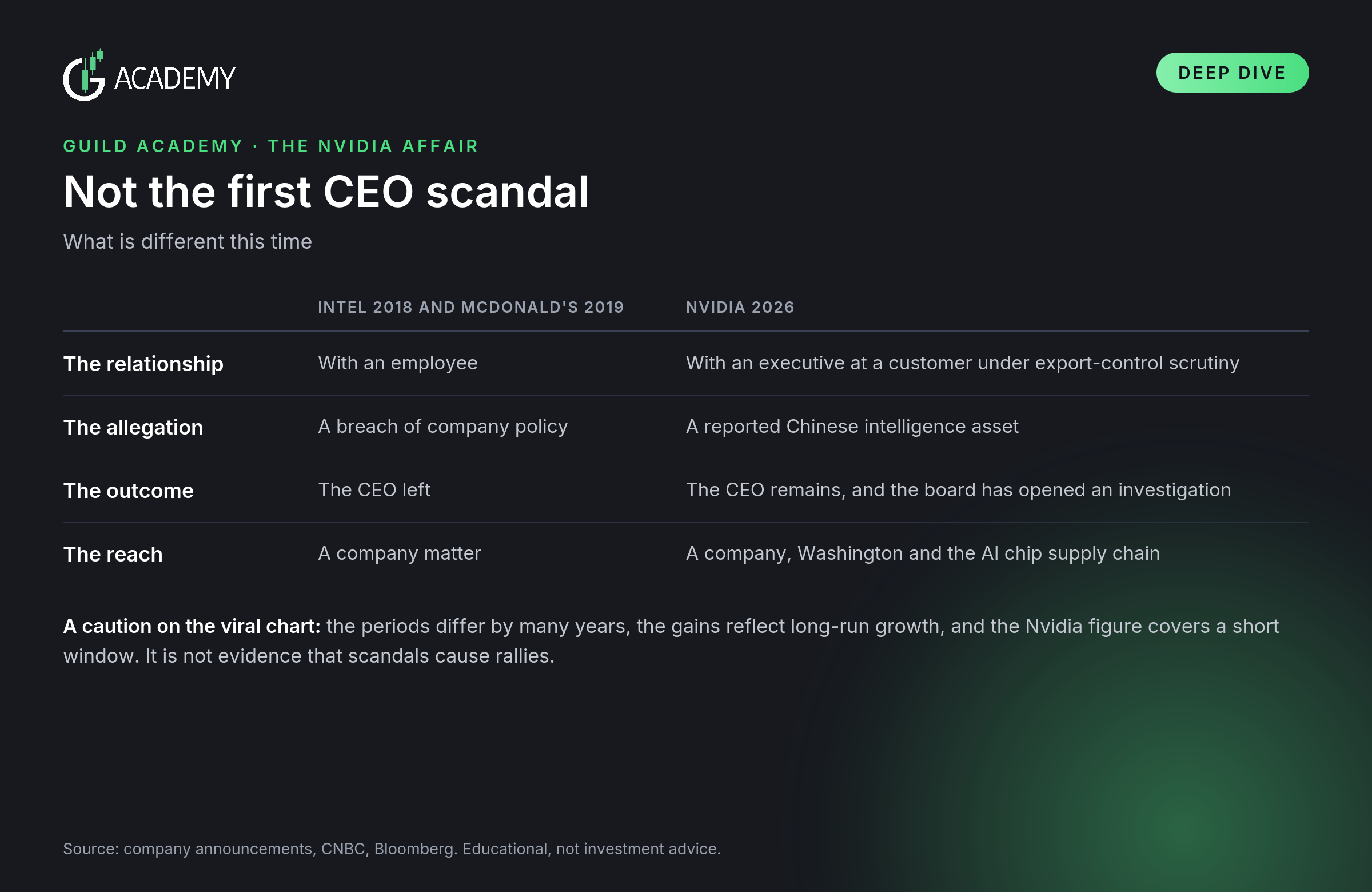
Nvidia is also not an ordinary company. It sits at the center of the AI chip trade, and Huang has argued publicly against restricting AI chip sales to China. That is why the personal story has a policy side.
The Policy Chain
The thesis is that this story works through Washington, not the boardroom, and that the end result could eventually read as bullish. It is a thesis, not a forecast, and each link has a fact behind it.
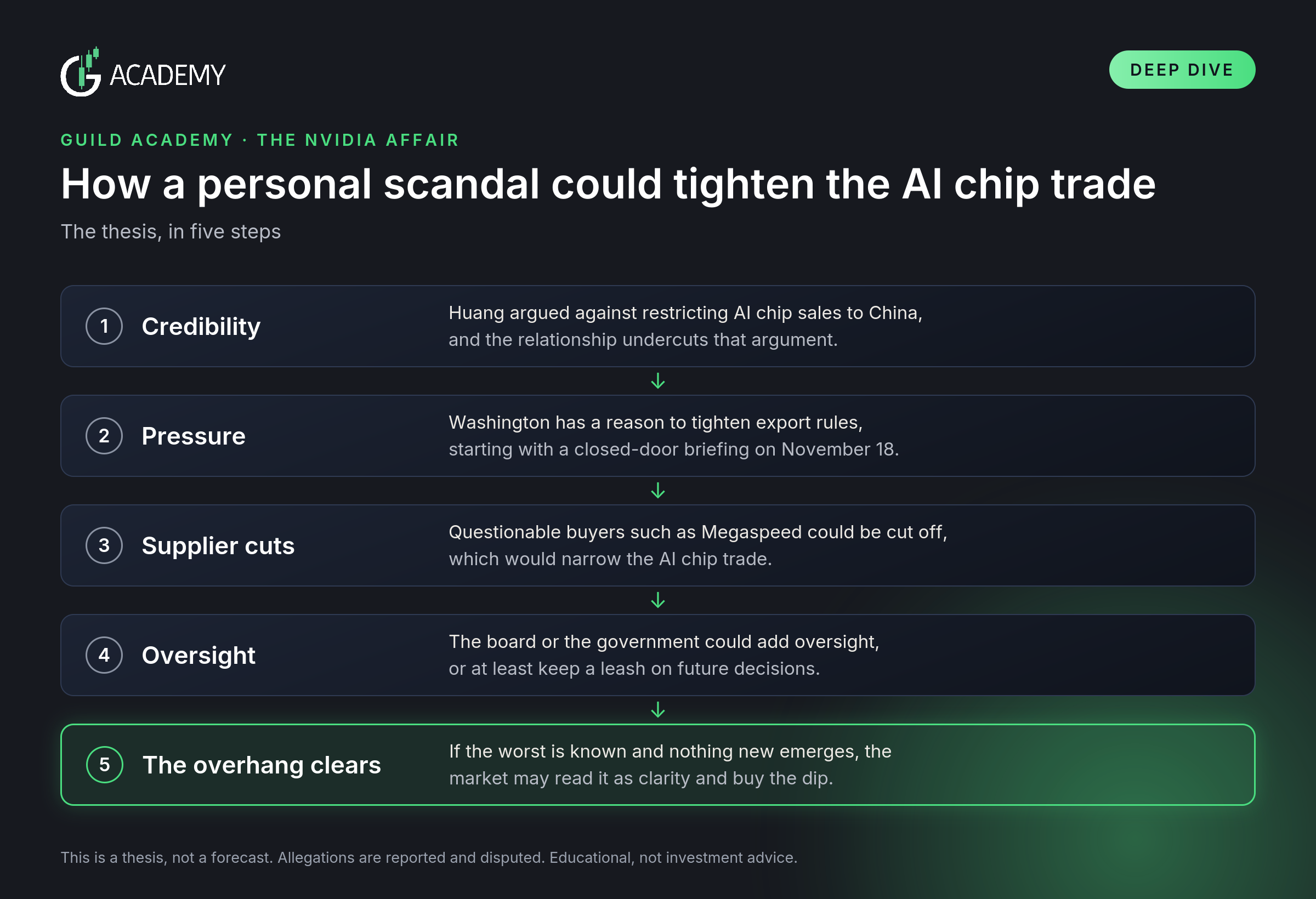
Credibility. Huang has argued against restricting AI chip sales to China, and a relationship with someone officials call a Chinese intelligence asset weakens that case.
Pressure. Three House committee chairs have asked him for a closed-door briefing on November 18, and a shareholder lawsuit and a board investigation are already under way.
Supplier cuts. Megaspeed was reported to be poised to buy about $2 billion of Nvidia AI technology over the next year, and the Commerce Department has been examining whether it helps Chinese firms avoid export restrictions. A crackdown on buyers like it would narrow the trade.
Limited direct exposure. Nvidia's third-quarter outlook assumes no China data center compute revenue, so a tighter China policy would cost it less than it would have a year ago.
Oversight. The board is assembling a committee of independent directors with outside counsel. Nvidia has no public succession plan, and the 63-year-old Huang has no obvious heir.
Why this could eventually look bullish: if the investigation finishes without new revelations, the uncertainty clears, export enforcement gets tighter, and the stock no longer carries the unknown. Markets tend to reward clarity, even after a hard drop.
The Nvidia Play
The biggest risk to Nvidia right now has little to do with AI demand. It is key-man risk, the possibility that Huang is pushed out or has to step down. A lot is priced into the stock, but that outcome was not. Think of UnitedHealth in 2025: when a company is hit by leadership turmoil and investigations, its stock can keep moving sharply for months as the story develops. The honest uncertainty is timing. Nobody knows how long this will take to resolve, and the risk is how far the stock moves along the way.
There are two plausible paths from here:
Huang stays and nothing else emerges. The stock could do well after earnings.
This turns out to be the worst of it. The drop could set up a dip that leads into the usual run before earnings.
The main danger is that Huang leaves. None of this is a recommendation to trade the stock.
The facts around the stock:
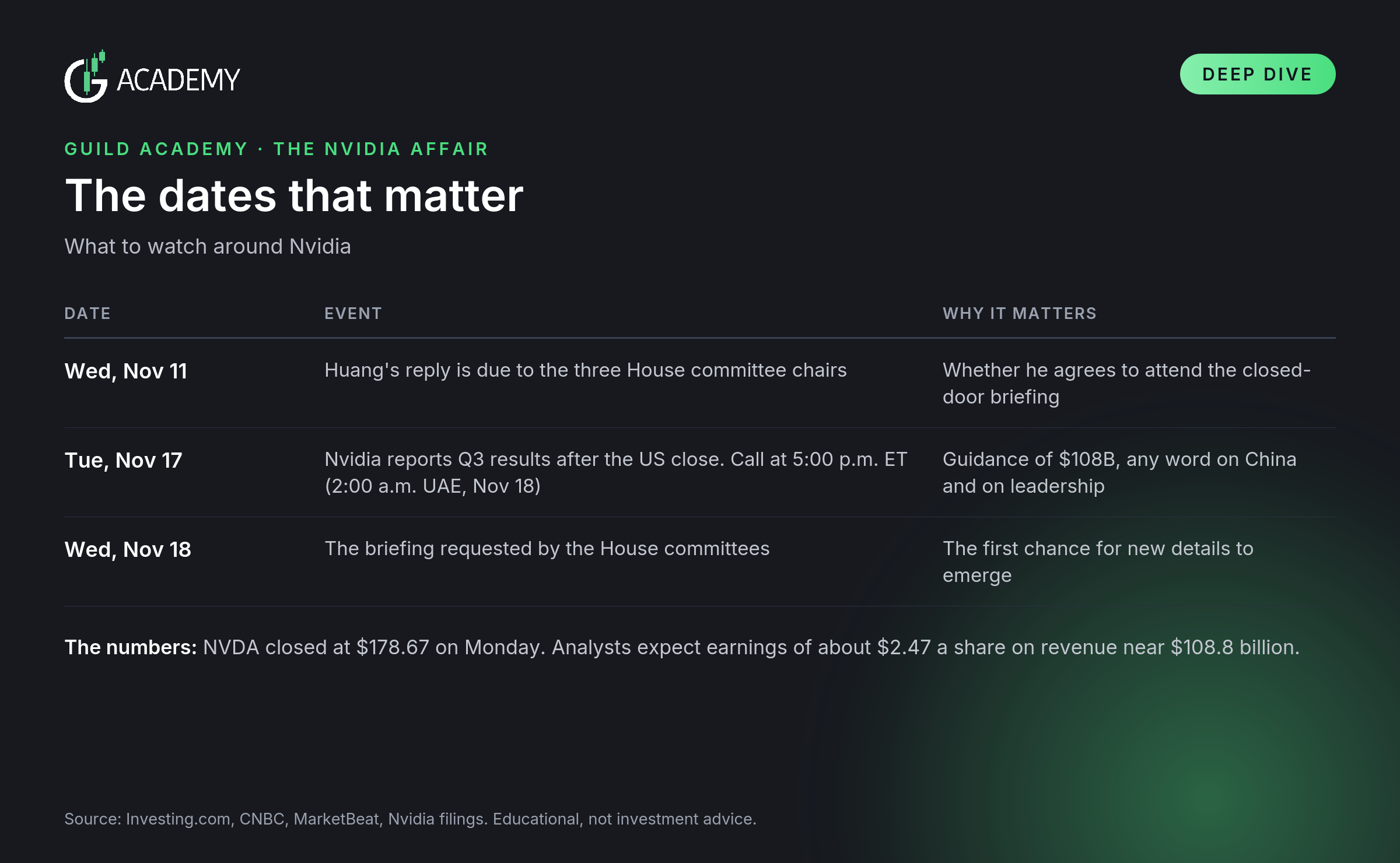
Nvidia closed Monday at $178.67, down from $186.64 on Friday, with about 24.1 billion shares outstanding.
It reports third-quarter results on Tuesday, November 17, after the US close, and guided to revenue of $108.0 billion, plus or minus 2%. Analysts expect earnings of about $2.47 a share.
Wedbush's Dan Ives called the probe a game changer for the CEO and the company, but said it does not change his view that Nvidia remains two to three years ahead of China in AI chips.
The chart going around cites a fair value of $241, about 30% above where the stock was on Friday. I could not verify the source of that figure, and it is about 35% above Monday's close.
The dates that matter:
The 2018 Test
The second idea is a simple test of whether this market is repeating 2018. After the midterms that year, stocks rallied the next day and then slid back below their Election Day levels within days, on the way to a December low. The rule of thumb is that if the market is still above its Election Day close by Wednesday, it has avoided the 2018 pattern.
Here is where the three main indexes stood at Monday's close, against Election Day, November 3:
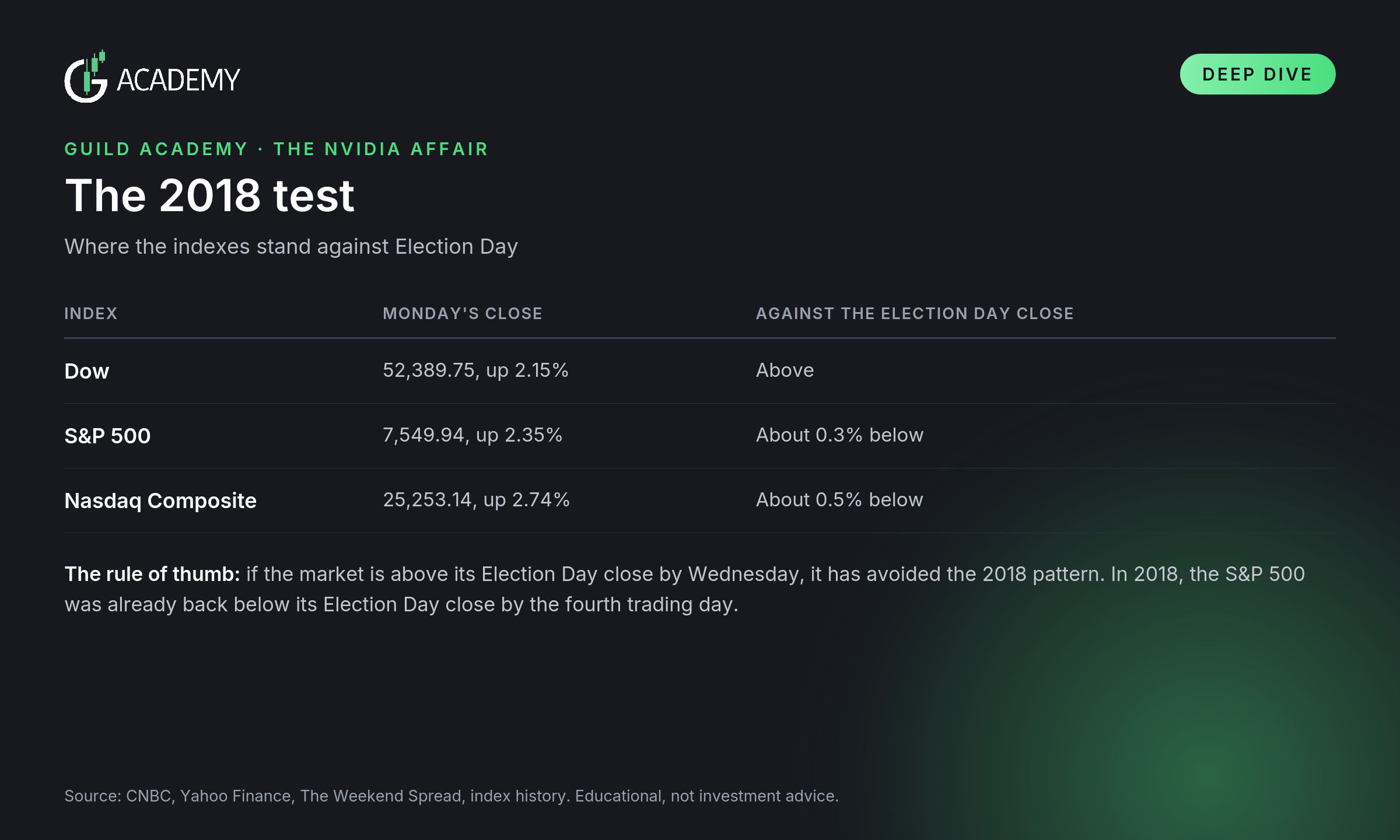
So the market is not yet up since the midterms, only the Dow is. The S&P 500 and the Nasdaq are close, and Wednesday, November 11, is the sixth trading day after the vote, so the test is still open. In 2018, the S&P 500 had already fallen back below its Election Day close on the fourth trading day.
Monday itself was a strong session. The S&P 500 had its best day since April 8, led by falling oil and a chip rebound, advancers beat decliners about four to one, and the VIX fell 22% to 19.92, its first close under 20 since the selloff began. Even so, strategists described it as far from the all-clear, and the cost of protection on the Nasdaq 100 rose relative to the S&P 500 as investors waited for inflation data.
Risks
Key-man risk. If Huang is forced out or steps down, the stock could fall further. Nvidia has no public succession plan.
Timing. The investigation has no announced timetable, so the stock can swing in either direction for weeks. Being right on direction while wrong on timing still loses money.
Industry-wide policy risk. A tougher export stance would hit the whole AI chip group, not only Nvidia. Bloomberg describes the scandal as a risk for the entire AI industry.
Contested facts. China calls the allegation unsubstantiated, Nvidia says its dealings with Megaspeed were normal, and the board has said it has no reason to believe secrets were compromised. The picture can change in either direction as the probe goes on.
A volatile backdrop. US inflation data is due on Tuesday, and the AI trade is still recovering from last week's drop.
Options can lose everything. Short-dated options on a stock moving this fast can expire worthless even when the story turns out as expected.
None of this is a recommendation to buy or sell anything. It is what the facts and the thesis suggest, so that existing plays can be reviewed with context.