Deep Dive: The Lookback Option, Wall Street's Hindsight Contract
Most option traders know the frustration of being right and still not getting paid. A stock jumps past your target, you hesitate, and by expiry the gain is gone. There is a contract built to remove that problem, and it is real. It is called a lookback option.
What a Lookback Option Is
A lookback option is an exotic option whose payoff depends on the best price the underlying reached during the option's life, not just the price on the last day. You do not need to sell at the exact high to be paid for the high.
This is the fixed-strike lookback call. Like a normal call, it has a strike price set when you buy and a premium you pay up front. The difference is the payoff. A normal call pays the final stock price minus the strike. A fixed-strike lookback call pays the highest price reached minus the strike, if that number is positive.
Take a $200 strike. If the stock reaches $230 at any point and then falls back below $200 before expiry, a normal call expires worthless. The lookback call still pays $30 per share, which is $3,000 on a standard 100-share contract.
There is a second version, the floating-strike lookback, which has no fixed strike at all. A call of this type lets the holder effectively buy at the lowest price seen during the option's life, so its payoff is the final price minus that low, and it always finishes in the money.
The Worked Example
The table compares a normal call with a fixed-strike lookback call, both with a $200 strike and the same expiry. Payoffs are per share, with the per-contract value in brackets.
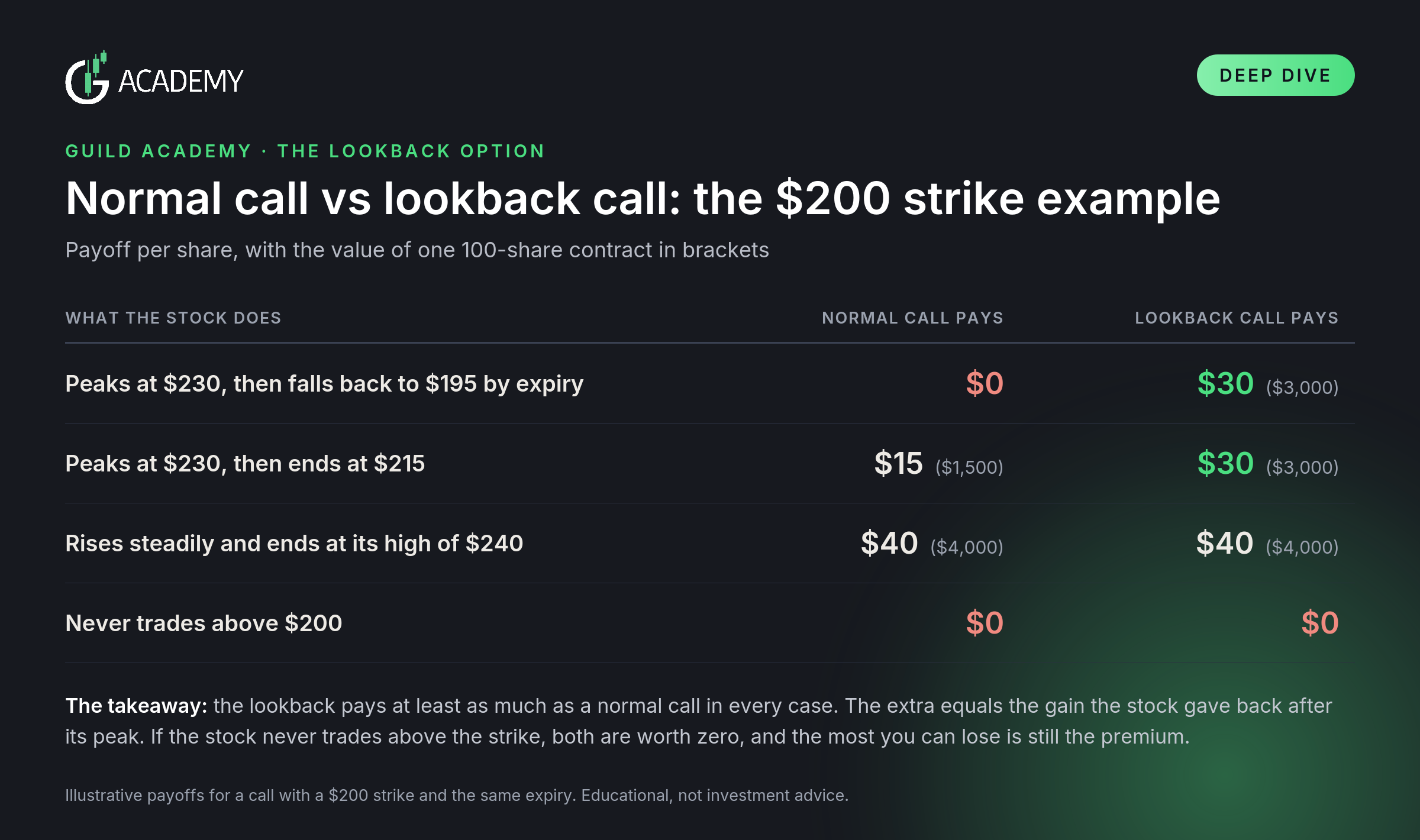
Three things follow from the table. The lookback call pays at least as much as a normal call in every case. It matches the normal call only when the stock finishes at its high. And the extra it pays is exactly the gain the stock gave back after its peak.
It also shows what the contract does not do. If the stock never trades above the strike, the lookback is worth zero, and the most you can lose is still the premium. It protects against giving back a gain, not against being wrong.
Is It Real, and Who Gets It?
It is real, and it is not a secret. Lookback options are a standard exotic in finance textbooks and professional exams, and banks have priced them with closed-form models for decades. What is true is that access is gated.
They trade over the counter. Lookbacks do not trade on the major exchanges. They are custom contracts negotiated with a dealer, unlike the standardized, centrally cleared options in a normal brokerage account.
The rules favor institutions and the very wealthy. In the US, off-exchange derivatives are generally limited to "eligible contract participants." For an individual, that means more than $10 million in assets, or $5 million if the trade is used to hedge a risk. That is the practical reason most retail traders never see these products.
A version of the idea does reach ordinary people. Many employee stock purchase plans include a lookback provision. The employee buys at a discount of up to 15% off the lower of the stock price at the start of the offering period and the price on the purchase date. A rising stock therefore hands the employee a much bigger bargain, which some advisers call a free option. It compares only two dates, not the best price over the whole period.
Cheaper variants exist. A partial lookback restricts the window in which the best price counts, which lowers the premium.
Why It Costs More
The price follows from the payoff. A lookback call pays at least as much as a normal call in every scenario, and often much more, so it has to cost more. In a standard model with 30% volatility and a 4% interest rate, a fixed-strike lookback call costs roughly 1.7 to 1.9 times a normal call with the same strike and expiry.
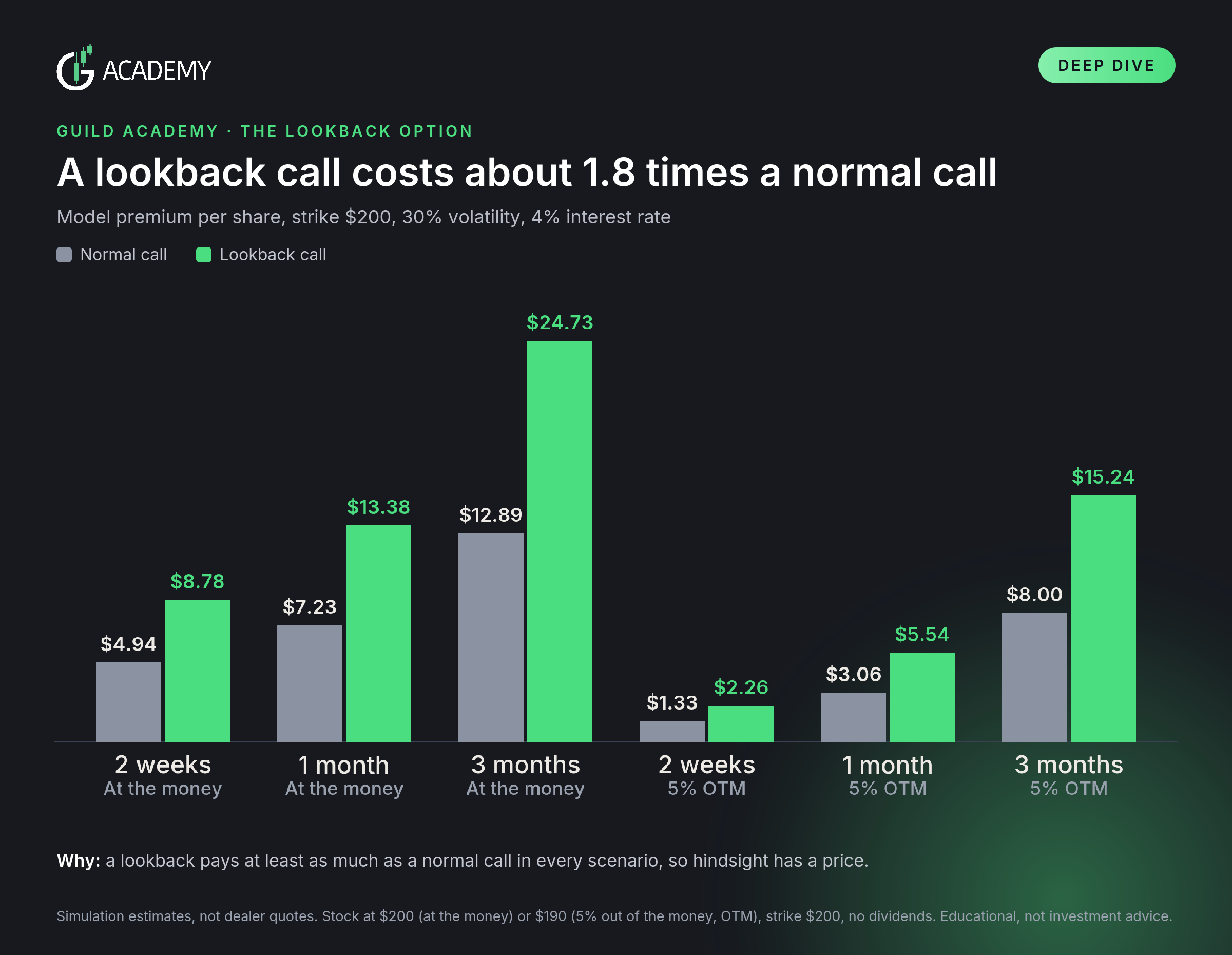
The premium is also hard for dealers to manage. The payoff depends on the whole path of the price, not just where it ends, so the seller cannot hedge with a simple, stable position. Gaps in the price, such as an earnings jump, make the risk bigger. A seller has to charge for all of that, and for the fact that every buyer gets the benefit of hindsight.
That is why lookbacks are rarely given away. The extra cost is the price of timing insurance, and the figures above are simulation estimates, not quotes from any dealer.
What Traders Can Do Today
Until lookbacks reach ordinary brokerage accounts, there are ways to capture some of the benefit with standard tools:
Use resting sell orders. A limit order at your target sells automatically, so you are not relying on being at the screen when the price touches it.
Scale out. Sell part of the position at the first target and leave the rest to run. This reduces the cost of being wrong in either direction.
Use spreads. Selling a higher-strike call against the one you own lowers the premium and sets a defined target. The gain is capped, but it is captured automatically if the stock finishes above the top strike.
Sell the option, not just the stock move. An option can be sold before expiry. Decide the exit before entry, including what you will do if the price hits target and then reverses.
Remember time decay. A normal option loses value every day, which is the cost of the timing it does not give you.
If retail lookbacks do arrive, the sensible test is the price. A contract that costs roughly double has to improve your results by more than double its extra cost, and the simple tools above cost nothing.