Deep Dive: How $6.3 Billion Was Stolen From Binance
On October 29, 2026, attackers drained about $6.3 billion from Binance's hot wallets, the largest cryptocurrency theft on record. Chainalysis puts the total slightly higher, at about $6.4 billion. The previous record was the $1.5 billion theft from Bybit in February 2025.
What Happened
The essentials:
When. The attack began around 20:05 UTC on October 29, and most of the money left within about an hour.
Where. Ten networks were hit, including Ethereum, Solana, Bitcoin, Tron and the XRP Ledger.
How. The attackers gained access to Binance's signing infrastructure, so every transfer carried a valid signature from Binance's own keys. On Ethereum, they also planted a trapdoor in one of Binance's busiest wallets using a feature called EIP-7702.
The result. About $3 billion was frozen on-chain. Binance says it will absorb the losses and has restored backing for 90% of the affected assets.
This report explains how the attack worked, step by step, and what it means for anyone who keeps money on an exchange.
How the Attacker Got In
Binance's initial investigation, published on October 30, attributes the incident to a compromised DevOps engineer's laptop. That gave the attacker access to a service container used to submit withdrawals. Binance says it found no evidence that a wallet private key leaked.
That distinction matters. A signing service is the system that turns a withdrawal request into a cryptographically signed transaction. Whoever controls it can request real signatures without ever seeing the keys. Every transaction that drained the wallets was therefore authentic from the blockchain's point of view. This was a compromise of how Binance signs, not a break in the cryptography and not a flaw in a smart contract.
The attacker prepared well in advance. About 36 hours before the theft, an operator wallet was funded in small amounts through the Tornado Cash mixer. At 02:28 UTC on October 29, the attacker deployed a test version of the draining contract and tried it on disposable wallets. At 15:59 UTC, about four hours before the attack, the live version went on-chain.
The attack was also not limited to one wallet. Separate Binance wallets on every network, each with its own keys, signed ordinary transfers straight to the attacker. A compromise that reaches so many wallets at once points to the signing path, not to any single leaked key.
The Trick: EIP-7702 and the Nonce Spray
An ordinary Ethereum wallet holds no code. A key controls it. Since the Pectra upgrade in May 2025, a new transaction type, type 4 (EIP-7702), lets a wallet sign an authorization that makes it run a smart contract's code as its own. It was designed for convenience, for example to bundle an approval and a transfer in one step, and the owner can undo it by signing another authorization.
Two things are needed for an authorization to work. The first is a valid signature from the wallet, which the compromised signing service could supply. The second is the wallet's current nonce, a counter that rises with every transaction the wallet sends, like the serial number on a cheque. Binance 14 was a busy withdrawal wallet, so its nonce kept changing, and the attacker could not know the exact value at the moment their transaction would land.
The solution was to cover every likely value. One type-4 transaction at 20:20:59 UTC carried 50 authorizations, each signed by Binance 14, for consecutive nonces from 18,914,775 to 18,914,824. Exactly one matched, at nonce 18,914,809, and took effect. From that moment the wallet ran the attacker's contract, a sweeper that only the attacker's address could call. It could move every token balance, withdraw the ETH and make arbitrary calls on the wallet's behalf.
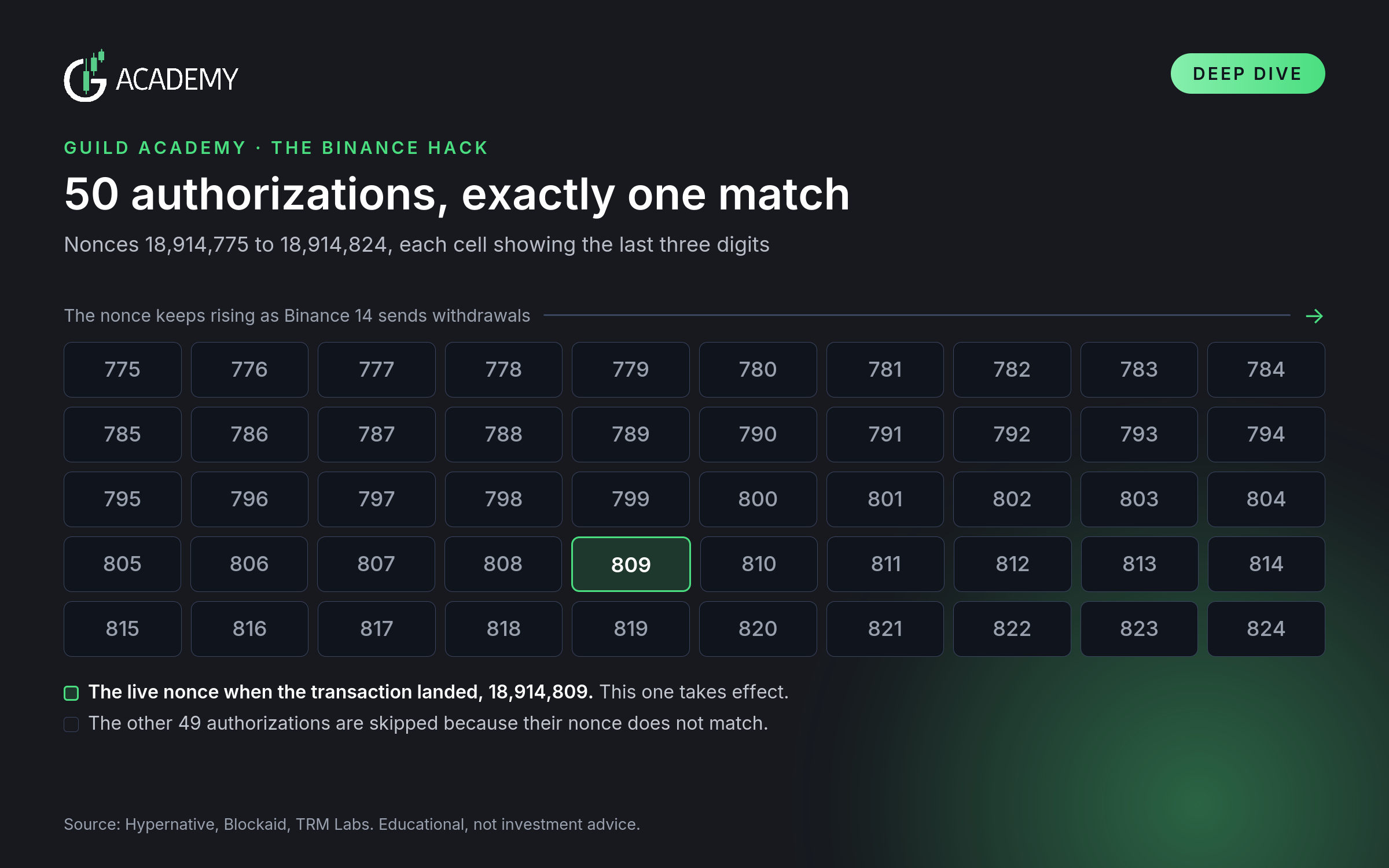
The grid shows the idea. The attacker could not know which nonce the wallet would be on when the transaction landed, so every plausible value got its own signed authorization. All but one were skipped, and the one that matched was enough.
The drain itself was a single call. At 20:24:23 UTC, about three and a half minutes after the takeover, the attacker called the sweeper and moved 167,464 ETH and 63 tokens, including about $1.61 billion of USDT, roughly $2.57 billion in total. No further signature was needed.
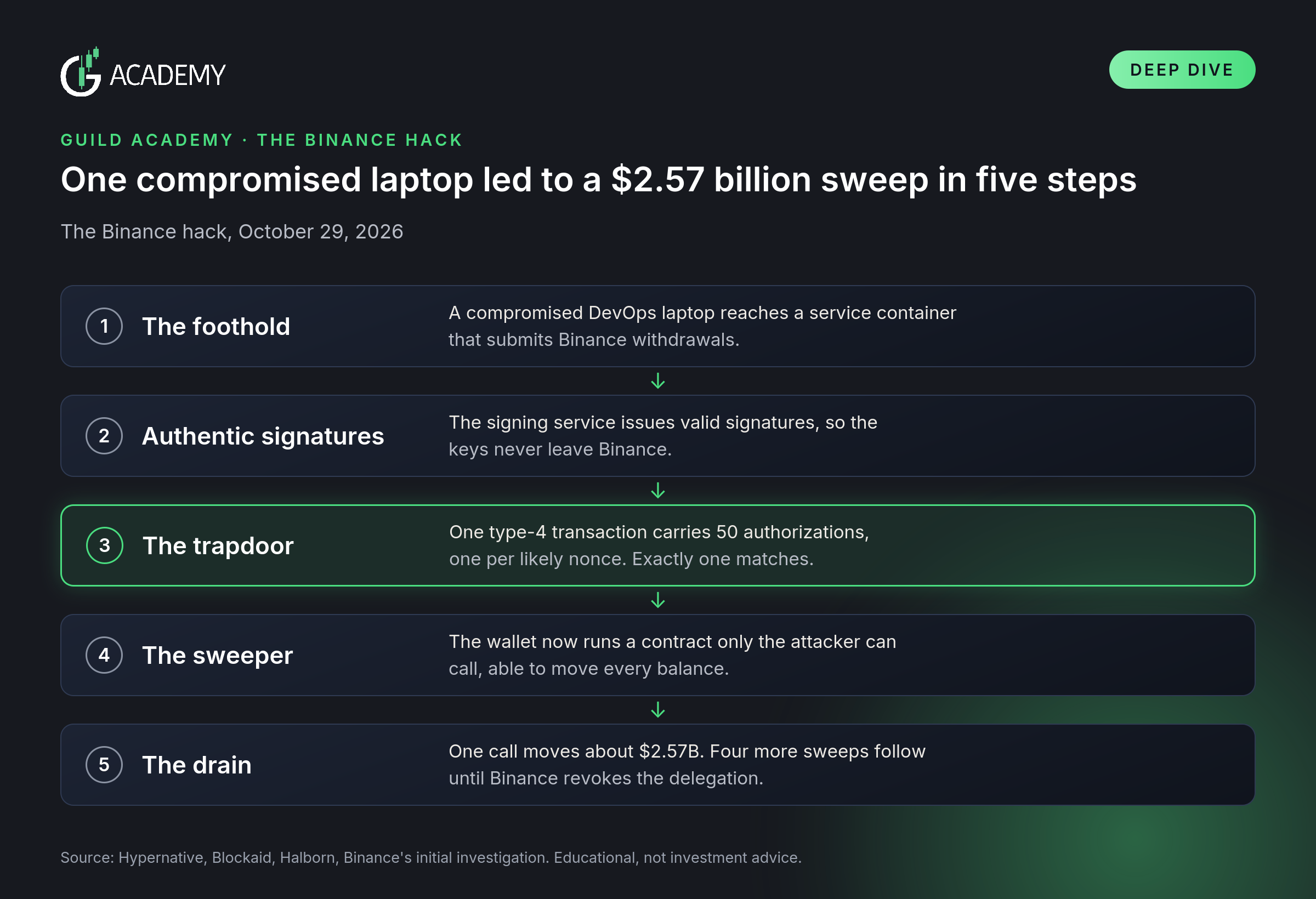
The diagram shows the chain of events. Each step depended on the one before it, and the first, a single compromised laptop, was enough to set the rest in motion.
The trapdoor then stayed open. The delegation belongs to the address, so it persists until it is replaced, and rotating a key would not have removed it. It also let the attacker call a Circle smart account whose only owner was Binance 14, pulling out about $823 million of USDC. As new deposits arrived, the attacker swept the wallet four more times, at 21:04, 21:44, 22:39 and 23:56 UTC. Binance finally revoked the delegation at 00:10 UTC on October 30 by submitting its own type-4 transaction that pointed the wallet to the zero address, which clears it.
EIP-7702 itself was not broken. Derek Chiang of Ethlabs argued exactly that, since the attacker still needed a valid signature, and the signing service provided one.
The sequence of events, in UTC:
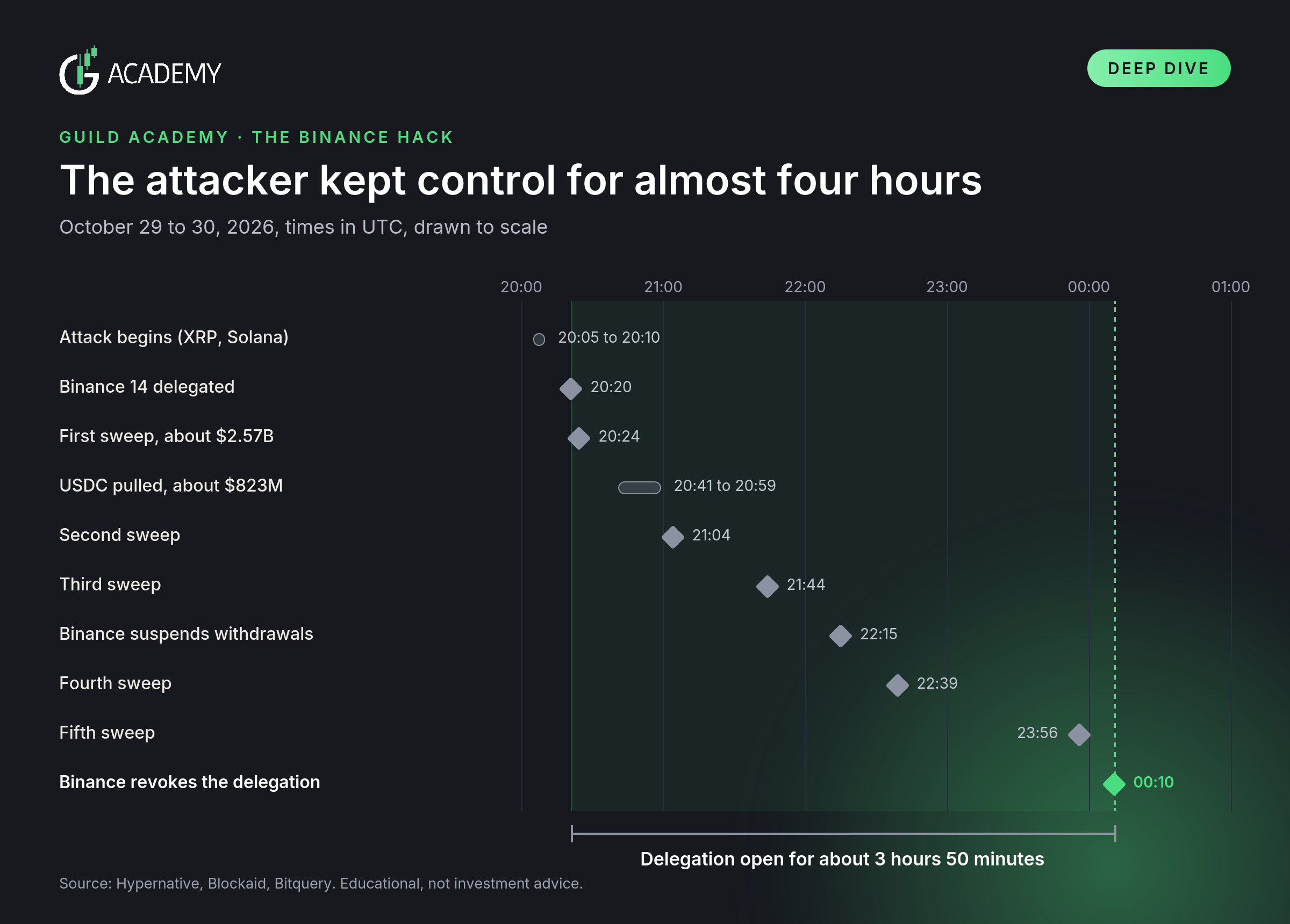
Drawn to scale, the timeline shows how little time the takeover itself needed and how long the trapdoor stayed open afterward. The first sweep came minutes after the delegation, and four more followed as deposits arrived.
The Aftermath
The response. Binance suspended deposits and withdrawals at 22:15 UTC on October 29. About $3 billion was frozen on-chain with help from stablecoin issuers including Tether and Circle, and the delegation was revoked at 00:10 UTC on October 30.
Who pays. Binance said users would not bear the loss and that it would cover everything from its SAFU emergency fund and company funds. By October 31 it said it had restored backing for about 90% of the affected assets, with BTC, ETH, USDT, BNB, SOL, USDC, XRP, USD1, RLUSD and ZEC fully backed. It is buying the rest through market and over-the-counter channels, has committed to topping SAFU back up to about $1 billion, and has promised an updated Proof of Reserves.
Withdrawals. Binance resumed withdrawals in phases on Sunday, starting with the Bitcoin network and then Ethereum and BNB Smart Chain.
The market. Bitcoin slid from near $80,000 to an intraday low of $76,443 on October 30, and about $1.57 billion of crypto positions were liquidated in 24 hours.
Who did it. Chainalysis attributes the theft to North Korea's TraderTraitor group, citing stolen funds mixing with proceeds of last month's Bitget exploit. Hypernative has not independently confirmed that attribution.
Where the money is. The ETH, SOL and BTC cannot be frozen because they have no issuer. The stolen BTC is reportedly being split into chunks of about 1,000 BTC, a common step before laundering.
Where the Money Stands
The losses fall into several groups, and not all of them are in the same position:
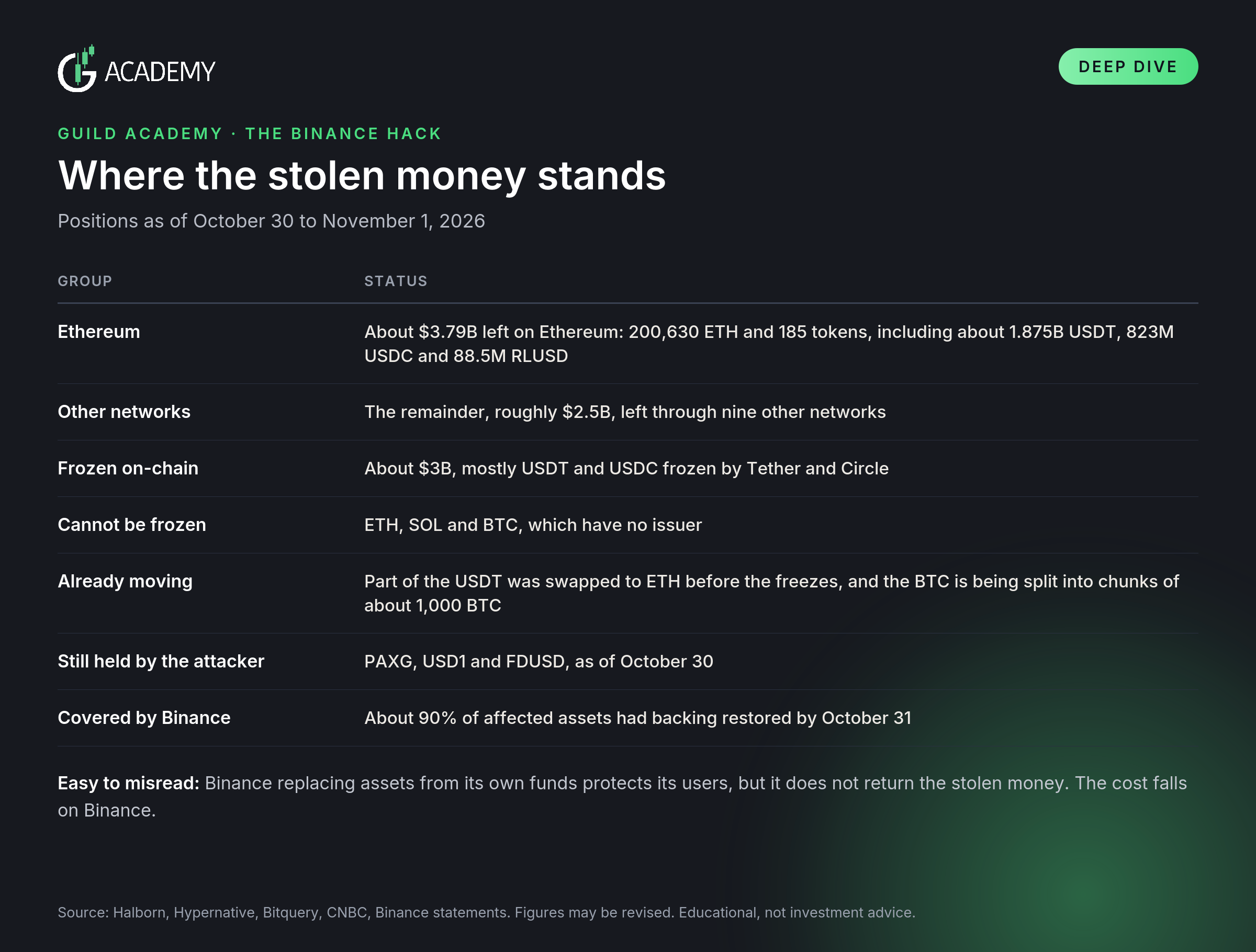
Binance replacing assets from its own funds protects its users, but it does not return the stolen money, and the cost falls on Binance.
How Exchanges Can Defend Against This
Security firms that studied the attack agree on a set of controls. None depends on knowing in advance how the keys will be compromised, since each acts on the behavior the compromise produces.
Screen every delegation before signing. A policy that denies EIP-7702 delegations to untrusted contracts would have refused the signature at 20:20. The sweeper had been flagged as malicious more than four hours earlier.
Watch for the pattern. A type-4 transaction carrying many authorizations across consecutive nonces is a clear indicator of compromise for any treasury wallet.
Simulate and limit withdrawals. Checks on size, speed and new recipients can block a balance-sized transfer to a brand-new address, and a circuit breaker can pause a wallet whose behavior suddenly changes.
Do not rely on hardware alone. A hardware security module will sign whatever an authenticated service asks it to, so protecting the service and the people who can reach it matters as much as protecting the key.
Monitor from the outside. One security firm flagged the attack within two minutes, and another flagged the sweeper when it was deployed. Independent monitoring is faster than waiting for the exchange's own alarms.
Hold less in hot wallets. What is not online cannot be swept.
What Traders Should Take From It
This was an infrastructure failure at the world's largest exchange, and it holds lessons for anyone who keeps money on a trading platform:
Platform risk is real, even at the biggest venues. Users were covered this time because Binance had the resources to cover them. That is not guaranteed at every platform.
Keep only what you need to trade on any one venue. Funds you do not plan to trade are safer in your own custody, which comes with its own responsibilities.
Look at how a platform protects customers. Segregated client funds, an insurance fund, published Proof of Reserves and a clear incident report all matter. Binance has promised an updated Proof of Reserves.
Frozen withdrawals are a cost too. Users could not withdraw from the evening of October 29 until phased reopening began on Sunday, even though balances were said to be safe.
Plan for volatility around news like this. Bitcoin fell about 4% and roughly $1.57 billion of positions were liquidated in a day. Position size and stops decide whether a day like that is survivable.
What it does not mean. This was not a flaw in Ethereum or in EIP-7702. It does not show that crypto itself is broken, and Binance says its users will not bear the loss. The weak point was a corporate system: a compromised laptop that led to a signing service.
Questions Traders Are Asking
Are my funds on Binance safe? Binance says users will not bear the loss and reports that about 90% of the affected assets are backed again. Withdrawals have resumed in phases. It is still platform risk, and the right response is to keep only what you need to trade on any venue.
Was Ethereum or EIP-7702 broken? No. The feature worked as designed, and the attacker needed a valid signature from the wallet's own key, which the compromised signing service supplied.
Could a stranger do this to my own wallet? Not without a signature from your key. The lesson for individuals is never to sign an authorization or delegation you do not understand.
Can the stolen money be recovered? About $3 billion is frozen, but the rest is moving, and none of it can be assumed recoverable.
Did it affect other exchanges? Binance.US was reported to be unaffected.
Why 50 authorizations? Because the wallet's nonce kept changing, the attacker covered a range of 50 consecutive values so that one would match when the transaction landed. One did.
What Is Still Unknown
How the laptop was compromised. Binance has said where the attack started, not how the attacker got into the engineer's laptop. A full post-mortem has been promised.
The final numbers. Binance puts the impact at about $6.3 billion and Chainalysis at about $6.4 billion, and figures for frozen and recovered funds are still moving.
Attribution. Chainalysis points to North Korea's TraderTraitor group, but others have not independently confirmed it.
What is recovered. About $3 billion is frozen, but the rest is moving, and none of it can be assumed recoverable.
Binance.US was reported to be unaffected.