Deep Dive: Black October and the Cybersecurity Trade
A wave of critical software flaws has hit the foundations of the web within a single week, and the market has noticed. Cybersecurity stocks have rallied hard, but the trade is further along than it looks.
What Is Happening
PHP2Shell. On October 21, PHP released emergency patches for two critical flaws, CVE-2026-109618 and CVE-2026-109619, each rated 9.2 out of 10. They let an attacker with no account run code on a web server. PHP runs an estimated 70% of websites, including WordPress and Drupal. Researchers at Wiz, OpenAI and Calif found the flaws in August, and PHP shipped the fix a day early after the identifiers leaked online. Exploitation followed quickly. Mirai botnet operators joined the attacks, a security firm built an exploit that gets past a key memory protection, and Unit 42 has confirmed a real-world compromise. Several government, school and hospital sites in Europe went dark on October 21, and the UK government said 32 of its services were unavailable. The FBI and NSA urged organizations to patch.
Follow-on issues. On October 23, PHP warned of another possible code-execution risk, CVE-2026-115560. It affects only unusual configurations and will be fixed in the regular release cycle, so the patch story is still developing.
HTTP2Shell. A separate flaw, CVE-2026-111497, sits in the Brotli decoder that many HTTP stacks use. It affects Node.js, Python, Bun, Envoy and others, and OpenAI discovered it. Bun shipped its fix on October 22 and adopted the HTTP2Shell name on October 24. Because Brotli is bundled inside many runtimes, each one has to be patched on its own, and the bug reaches across more of the modern web stack than PHP does. Reports of exploitation in the wild are still contested.
The common thread is that AI tools found these flaws, and the same tools can speed up exploiting them. That is why security spending is back in focus.
How the Stocks Reacted
The sector responded within hours. On October 21, Zscaler, Okta, Cloudflare and CrowdStrike rose 5% to 7% intraday. Over the week of October 19 to 23, Okta gained about 14%, Palo Alto Networks and CrowdStrike about 11% each and Cloudflare about 9%. Evercore's channel survey pointed to firmer security budgets and named PHP2Shell as a catalyst. A Jefferies reseller survey found no reseller reporting a pipeline decline for the first time in 11 quarters. Morgan Stanley expects corporate spending on cybersecurity software to grow about 23% a year through 2028.
Two things make this rally fragile. First, the leaders were already stretched. In early October the cybersecurity ETF CIBR hit an all-time high, and CrowdStrike, Palo Alto and Fortinet were up 132%, 131% and 97% for the year. Second, the move is driven by headlines. Real spending takes quarters to reach earnings, while a news cycle lasts days.
That sets up a likely pattern. When the headlines fade, the premium fades with them, and profit-taking is likely once the story reaches a checkpoint, such as the first earnings reports that mention the patch wave. A second risk is that one of the premier names becomes the victim of one of these threats, which would hit the crowded names harder than the laggards.
Premier Names and Laggards
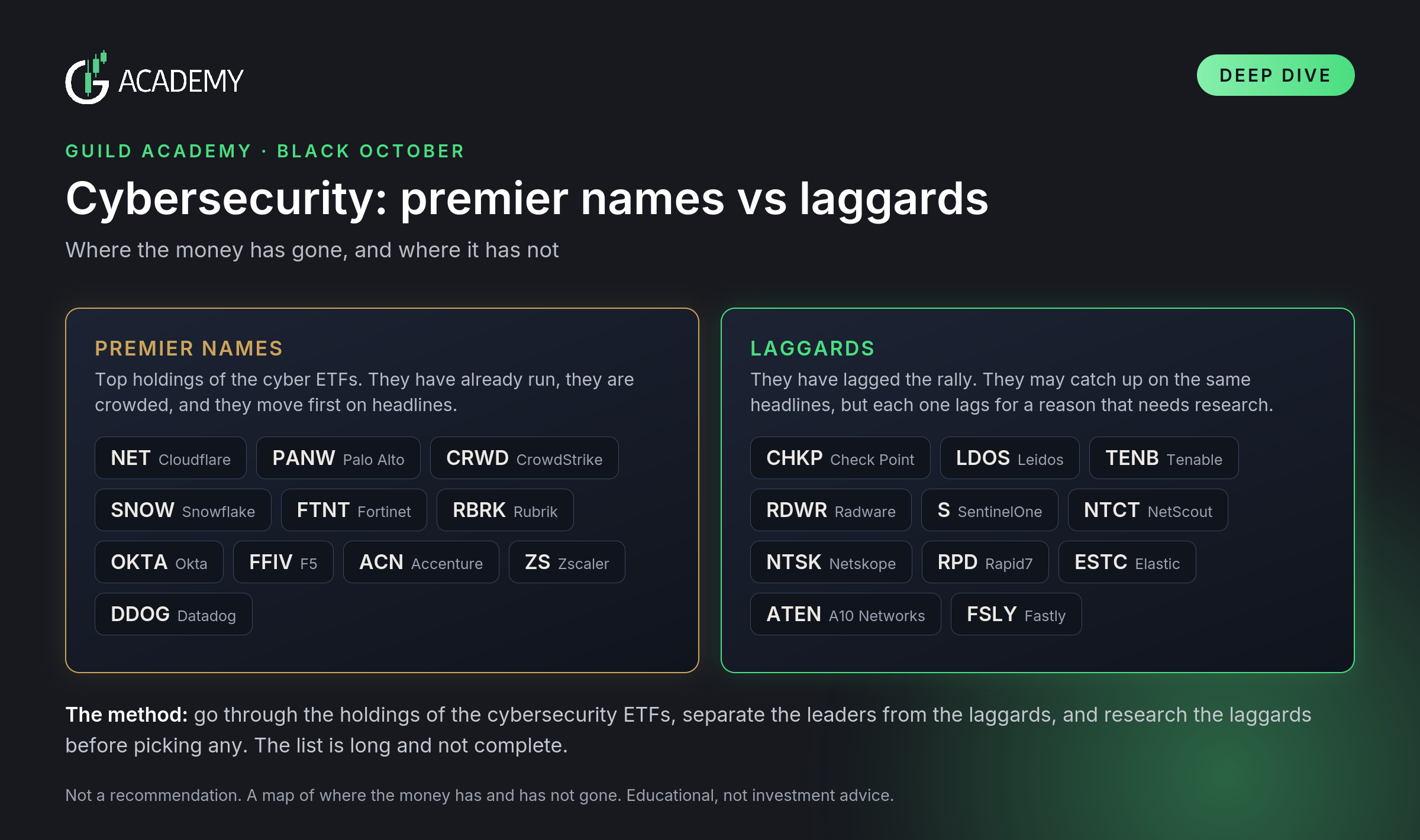
The method is the one laid out at the start of the year: go through the holdings of the cybersecurity ETFs, separate the leaders from the laggards, and research the laggards before picking any. The list is long, and it is not complete.
The Laggards in Focus
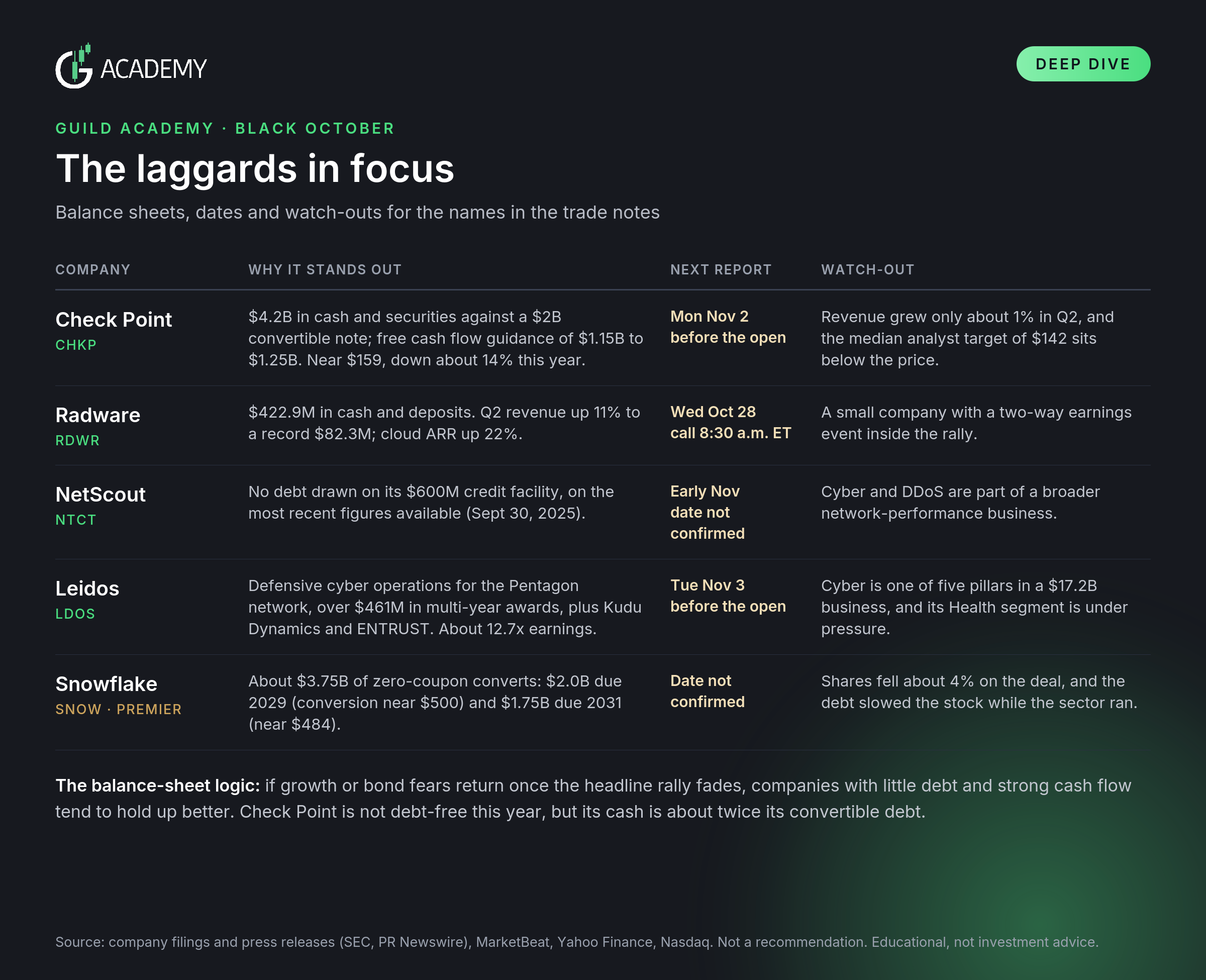
The balance-sheet logic is straightforward. If growth or bond fears return once the headline rally fades, companies with little debt and strong cash flow tend to hold up better than those carrying more. Check Point is not debt-free this year, but its cash is about twice its convertible debt.
The Okta Put
The case for the view. On October 22, Okta disclosed four vulnerabilities in its Access Gateway appliance. They include the PHP2Shell flaws in its bundled PHP runtime, a command-execution bug rated 9.1 that requires an authenticated administrator, and another rated 8.1. The company has also been here before: it took weeks to acknowledge a breach in 2022, and a late-2023 incident was later found to have affected all of its customers. And the stock has run, up about 14% this week, with a trailing P/E near 133 and a market value of about $37 billion.
The case against. Fixes for the Access Gateway flaws are available, and the most serious one needs admin access. An Evercore survey pointed to a strong Okta pipeline, and Citigroup raised its target to $215 with a Neutral rating. If the sector rally extends, a put loses money, and an options position needs the move to arrive on time. Okta's next earnings report is not until December 1, well after the news cycle may have faded.
The Plan and the Risks
The stated plan is to flip these positions quickly. That is a fast-moving style, and it is not for everyone. The positions described in the notes are shares and LEAPS in Check Point, shares in Radware, options on Leidos, NetScout and Snowflake, and puts on Okta. They are one trader's positions, not recommendations, and no guidance is given on when to sell.
Checkpoints to watch:
Wed Oct 28: Radware reports, and the Fed decides on interest rates.
Mon Nov 2: Check Point reports before the open.
Tue Nov 3: Leidos reports before the open, and the US midterm elections take place.
Tue Dec 1: Okta reports.
What could go wrong:
Timing. The early move has already happened, and anyone arriving now is not early.
Headline fade. If patching finishes quickly and the news cycle moves on, the premium can leave the laggards as well as the leaders.
Options decay. Short-dated options lose value every day, so being right on direction is not enough without being right on timing.
Two-way earnings. Radware, Check Point and Leidos can all move sharply in either direction on their reports.
The wider market. Cybersecurity has traded as part of the AI trade, so a renewed tech selloff, a hawkish Fed or higher oil can drag the group down.
Reasons for lagging. Some laggards lag for a reason. Check Point's growth is slow and analysts' median target sits below its price, and NetScout's cyber exposure is only part of its business.